 China Trip
Tianjin's Porcelain House: A 1920s Mansion Wrapped in Antique Shards
Status check (verified 2026-11-19): The house is open daily and the ticket is ¥50 for adults. The one thing to confirm before you go is the closing time — three different versions circulate (18:00 with last entry 17:40, 18:30, and 19:00 with last entry 18:30). Check the board at the gate or the ticketing app on the day.
On this page
Three things stacked into one building
The Porcelain House is not one idea. It is three, and knowing which one you came for decides whether you enjoy it.
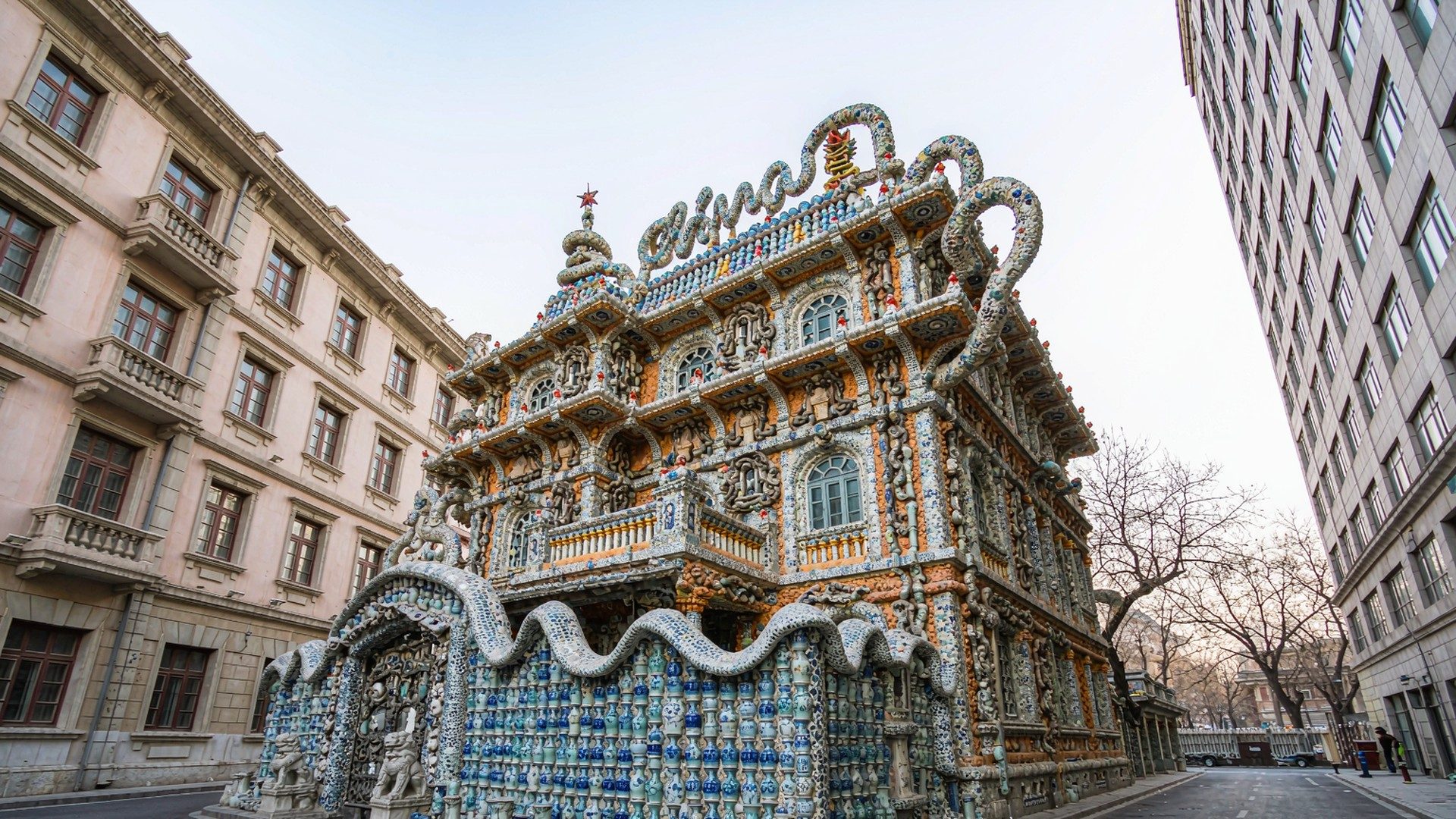
A house. Number 72 Chifeng Road, in Heping district, is a four-storey brick-and-timber mansion built in the late 1920s, with an Italianate external corridor and a hybrid, eclectic facade. Its first owner was Huang Rongliang, China's first consul-general in New Zealand and later minister to Austria, who moved in during 1927. The street was nicknamed "warlords' row" — fifteen regional commanders kept houses along it.
A collection. In 2002 the collector Zhang Lianzhi bought the building for 30 million yuan, intending to tile the eaves. A wall inset with broken porcelain changed the plan: he took his Tang sancai, Song and Yuan imperial wares and Ming and Qing pieces and used them as building material instead. It opened to the public on 3 September 2007.
A quantity. The fabric of the building now includes more than 700 million porcelain shards, over 13,000 complete vases, bowls and plates, some 300 carved stone figures, 300 white-marble lions, and more than 20 tonnes of crystal and agate. The shards span the Han through Qing dynasties and include pieces from all five great kilns.
That is the honest description: not a porcelain house, but a collection turned into a building.
What ¥50 buys
The courtyard wall. Some 630 late-Qing and Republican-era blue-and-white vases, stacked into a single wall at the entrance, meaning "safe passage in and out". In low sun the whole surface throws light back at you.
The roof dragon. A 768-metre dragon of porcelain pieces — the museum calls it the longest in the world — its body spelling out CHINA in Latin letters, its head built as a red five-pointed star. This is the silhouette every photograph of the place is really about. Shoot it from the opposite side of the street.
The Ming double-glazed lions. Four hundred years old, and among the few pieces here treated as a museum object rather than a surface.
The porcelain-wrapped Range Rover on the second-floor balcony. Entirely tiled. It explains the building better than any label: whatever was available went on the walls.
Two things most visitors miss: the danbi stone, a carved slab that only imperial buildings were permitted to use, here in a "phoenix over dragon" variant; and the spiral staircase, where the handrail, treads and walls are all tiled. The staircase is narrow, and when two flows of people meet, it stops.
Tickets: ¥50 adult; ¥30 for students, children, visitors aged 60–69 and Tianjin residents; free under 1.2 metres and over 70. Some booking channels list from ¥48.
Why foreigners found it first
In 2010 the Huffington Post put the Porcelain House on its list of the 15 most unique museums in the world, alongside the Louvre, the Pompidou and the Denver Art Museum. It was the only Chinese entry.
That list travelled further outside China than inside it, which produced an odd inversion: plenty of foreign visitors put "China House" at the top of a Tianjin itinerary, while domestic opinion remains genuinely split — roughly half find it astonishing, half find it garish.
The comparison that circulates abroad is with Gaudí's Park Güell in Barcelona, where broken glazed tiles are set into benches and lizards, a technique Catalan architecture calls trencadís. The Porcelain House does the same thing, except the fragments are datable antiques rather than modern tile. Foreign visitors call it "the porcelain Sagrada Família". The analogy is doing real work: it gives a first-time viewer a frame.
If you come asking "is this art?", you will spend the whole visit grading it. If you come asking "did somebody actually do this?", forty minutes is enough and you will not be bored.
Getting there, and the visa detail worth knowing
The house is a short walk from Heping Road station on Metro Line 3. Number 78 on the same street is the Zhang Xueliang residence (¥78), a few doors away; east takes you to Heping Road shopping street, west to Xikai Church. Half a day covers the cluster on foot.
For foreign visitors there is a second layer: Tianjin Binhai International Airport and Tianjin Port are both 240-hour visa-free transit ports. Arriving in Tianjin, continuing to Beijing, and leaving to a third country is a legal itinerary under that policy — the intercity train to Beijing takes about 30 minutes.
The city-level numbers explain why this is worth planning rather than stumbling into: Tianjin received 448,300 inbound visitors in 2025, up 21.2%, of whom 447,000 stayed overnight, 99.8% of the total, with foreign nationals making up 92.7%. In other words, people who come to Tianjin stay. The Ministry of Culture and Tourism has also put the city on its list of priority destinations for inbound tourism development.
Four things that will annoy you
- Weekend afternoons. One staircase, narrow corridors, two-way traffic. Go in the first hour after opening if you want empty frames.
- Photography inside. Recent visitor reports consistently say the inner exhibition rooms are off-limits to cameras; the exterior walls, dragon and balcony are fine. Follow the staff.
- "Worth 9.8 billion yuan." That figure circulates widely online. It is not an official valuation and there is no appraisal behind it. Do not repeat it as fact.
- The absence of interpretation. There is no sequenced exhibition, no labels in English, no audio guide. The building is the exhibit; you read it by walking.
Is it worth the stop?
Yes, for 40 to 60 minutes, if you treat it as an argument rather than an attraction. It is a private museum that is still acquiring things — in April 2026 a French choir member donated nearly 30 old masks, including Nuo opera pieces from Guizhou — and it is run with the logic of an obsessive rather than a curator.
Skip it if you want polish, chronology or quiet. Go if you want to see what one person's collection looks like when it is given a roof and a street corner.