Quanzhou Old City: No Tickets, 22 UNESCO Sites, One Mistake
Status check (verified 2026-10-25): Quanzhou's old city has no entrance ticket. Inside it, Kaiyuan Temple is free, the Confucian temple is free, the Guanyue Temple is free, and the Qingjing Mosque charges ¥3 — the whole walking day costs less than a coffee. The scarce resource is time, not money: the old city is usually sold as a half-day stop off the Xiamen train.
On this page
- What the listing actually is
- Kaiyuan Temple: the most valuable things inside are free
- West Street has two versions
- Tumen Street: four faiths in ten minutes
- What the city has actually built for foreign visitors
- Half a day, one day, or two
- The Xunpu question
- Getting there and getting around
- FAQ
- Does Quanzhou old city have an entrance ticket?
- Is Kaiyuan Temple free, and do I need to book?
- Can I do Quanzhou as a half-day trip from Xiamen?
- How much does a day in the old city cost?
- Is the 240-hour visa-free transit usable here?
- What should I wear at the Qingjing Mosque?
- When is the best time to visit?
- What's worth booking ahead
Quanzhou does tickets backwards. In most Chinese historic towns the walled core is the paid part and everything outside it is free; here the UNESCO listing runs through the middle of an ordinary working city, and the buildings that carried the listing are free to walk into.
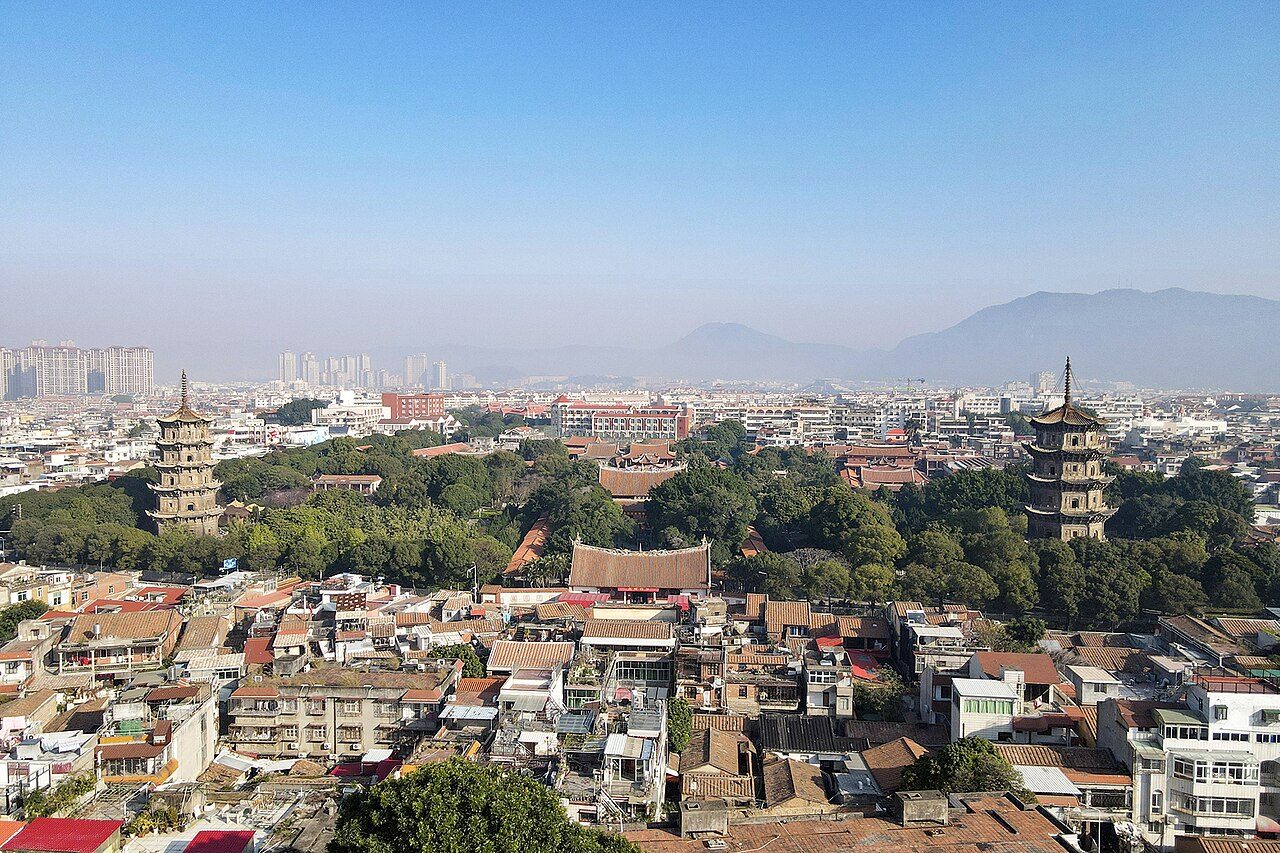
The listing is "Quanzhou: Emporium of the World in Song-Yuan China", inscribed in 2021, and it is spread across 22 component sites rather than concentrated in one walled compound. The core of it — the temples, the mosques, the lanes — sits in Licheng district, within about two kilometres of West Street.
What the listing actually is
Between roughly the tenth and fourteenth centuries, Quanzhou (then known in Arabic and Persian sources as Zayton) was one of the largest ports on earth. Arab, Persian and Indian merchants ran businesses on these streets, built temples on them, and were buried on the hills outside the walls.
What survived is not a restored set-piece. It is a district where a Buddhist temple, a mosque, a Confucian academy and a folk shrine sit within a ten-minute walk of each other, and where the Hindu stonework was reused as structural material in a Buddhist hall because it was already there and it worked. That layering — not any single monument — is what the inscription recognises.
So the useful question is not "what is there to see" but "how much time does this deserve". The common answer, half a day on the way to or from Xiamen, is the one that costs you the trip.
Kaiyuan Temple: the most valuable things inside are free
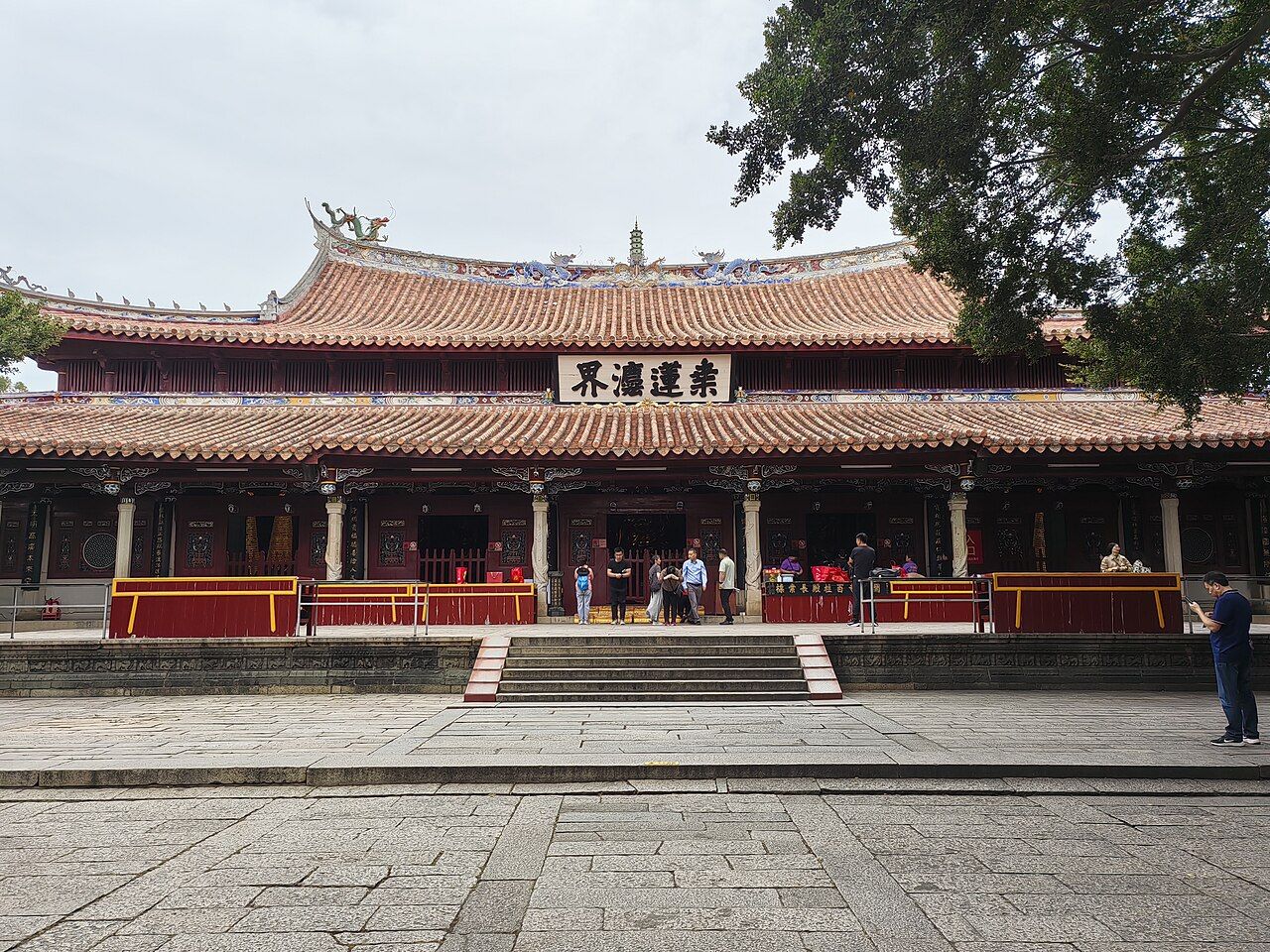
Kaiyuan Temple was founded in 686, in the Tang dynasty, and is the largest Buddhist complex in Fujian. Two things in it are famous, and neither is behind a ticket window.
The twin pagodas. Zhenguo (East) and Renshou (West) are Song-dynasty stone structures over 40 metres tall, and they are the tallest surviving Song stone pagodas in China. Every storey carries a different set of relief carvings, cut by Southern Song masons and never replaced. In the Wanli era of the Ming dynasty, a magnitude-8 earthquake hit Quanzhou; the pagodas stayed up.
A mulberry tree. The temple's founding story turns on one: the land was a mulberry garden, the owner dreamed of white lotus flowers opening on the trees, and he gave the plot up for a monastery — which is why Kaiyuan was first called the Lotus Temple. A single tree explaining an entire temple's origin is a very Quanzhou kind of fact.
Two more things get walked past. The main hall is known as the Hundred Pillars Hall, and among its columns are stone shafts carved with Hindu reliefs — Shiva, Vishnu — standing in a Buddhist hall with nobody finding it odd. Behind it sits the Ganlu Ordination Altar, one of the three great ordination platforms in Chinese Buddhism, and the room most visitors miss entirely.
Entry is free, but the temple asks visitors to book ahead on its official WeChat account, and the form is Chinese-only and built around a Chinese ID number. If it will not take a passport, the gate is the fallback — carry the document. Published opening times disagree with each other (6:00 and 6:30 both appear), the gates close around 17:30, and some halls shut briefly at midday. Plan around the temple's own notice for the day, not around a blog post's timetable.
West Street has two versions
West Street is the spine of the old city: from the clock tower it runs west, straight at the temple.
The main street is loud and commercial, and what it sells you could buy in any historic quarter in the country. The old city is in the lanes off it — Jinyu Lane and Jingting Lane — where the walls are red brick, the doorways are low, and the noise drops away within fifty metres.
For the postcard shot of the pagodas, go up rather than across: several cafés on West Street have roof terraces, and the price of the view is one drink and half an hour. Photographing from street level mostly gets you the back of other people's phones.
Tumen Street: four faiths in ten minutes
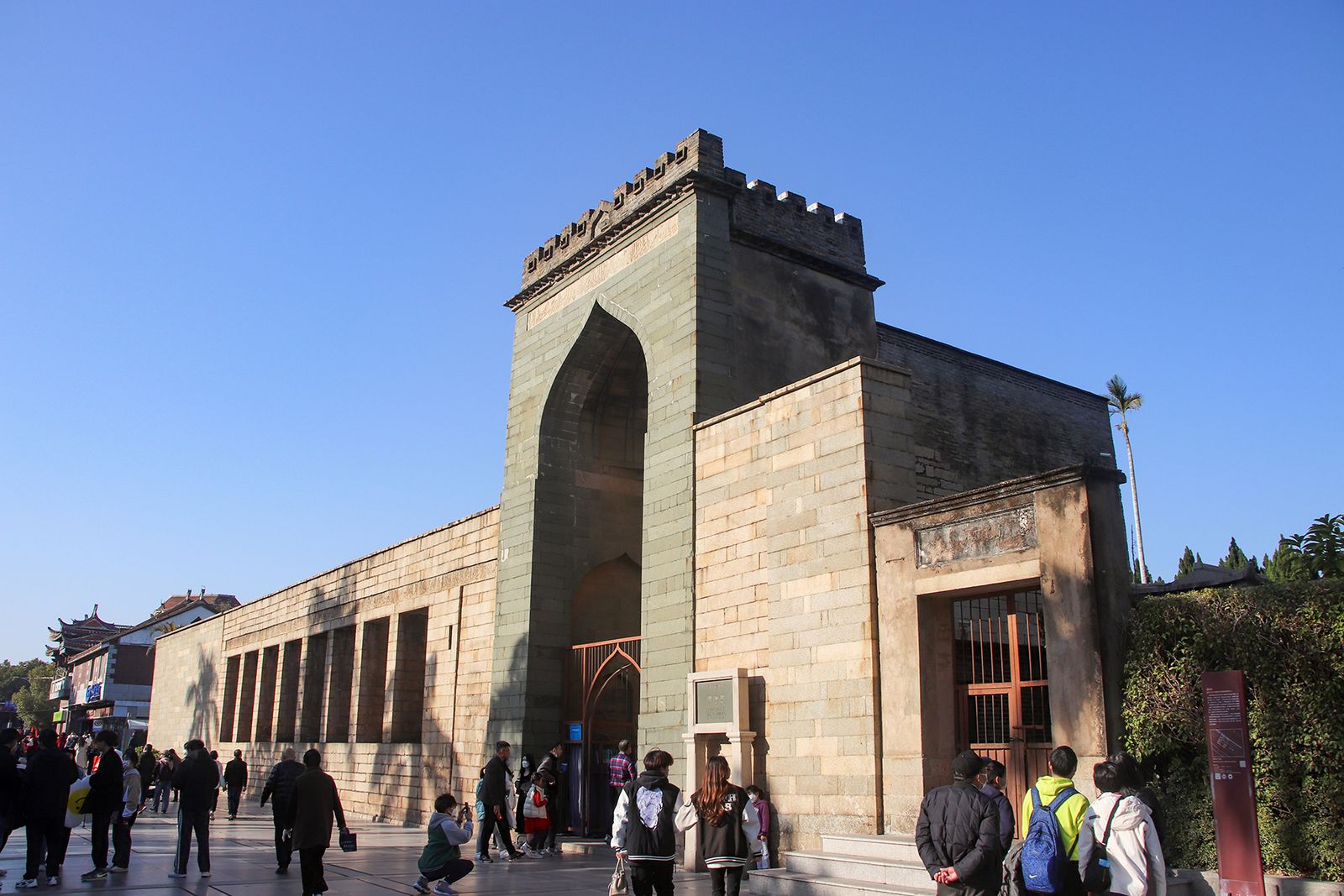
Tumen Street is the least scenic and most alive stretch of the old city, because it is not staged for visitors.
The Qingjing Mosque was built in 1009, in the Northern Song, and is one of the oldest surviving mosques in China. The arched stone gateway, the dome and the Arabic inscriptions are all still there, pressed up against Minnan red-brick shopfronts in a combination that is genuinely hard to describe. It charges ¥3. It is a working religious site: cover the knees, take shoes off inside, and expect the midday prayer period to be closed to visitors.
East of it is the Confucian temple, free, with a courtyard that is usually empty. Further on is the Guanyue Temple, the busiest shrine in the city, also free, its red walls carrying coloured porcelain-sherd sculpture that looks better after dark. Incense sticks are handed out inside at no charge; the people outside selling "blessing packages" are selling nothing you need.
Buddhist, Muslim, Confucian and folk — four traditions, ten minutes on foot, no ticket between them.
What the city has actually built for foreign visitors
In October 2026 Quanzhou was named one of the top ten cases in the country for improving inbound-tourism service, announced at the 13th China Tourism Industry Development annual conference. Awards are cheap; here is what is on the ground.
- Jinjiang International Airport (JJN) is a 240-hour visa-free transit port — in place since December 2024 — with Fujian province as the permitted area of stay. The airport has an inbound service desk where tourist information, currency exchange and a local SIM are handled at one counter.
- The 22 heritage sites carry multilingual signage and audio-guide hardware; the old city has close to 50 staffed "one-button" visitor huts for real-time translation and bookings.
- Foreign-card terminals are installed across 4A-level sites and star-rated hotels, and there are departure-tax-refund counters in the central districts.
- Border inspection runs 14 manual lanes and 10 fast lanes, and customs takes advance luggage declarations.
The numbers behind the push: in 2025 Quanzhou recorded close to one million inbound visitors, with inbound spending above US$1 billion, up 34.5%. In the first half of 2026, inbound spending grew more than twice as fast as visitor numbers — fewer new arrivals, more money per arrival.
Half a day, one day, or two
Half a day. West Street plus Kaiyuan Temple, on foot, two to three hours. It works, and it will leave you with the impression that Quanzhou is a commercial old street with one good temple. That is the thinnest version of the city.
One day. Kaiyuan Temple in the morning (including the ordination altar and the mulberry), the lanes off West Street at midday, Tumen Street in the afternoon for the mosque, the Confucian temple and the Guanyue Temple, then back to a West Street roof for the pagodas at dusk. It is all walkable, and the day's total ticket spend is ¥3.
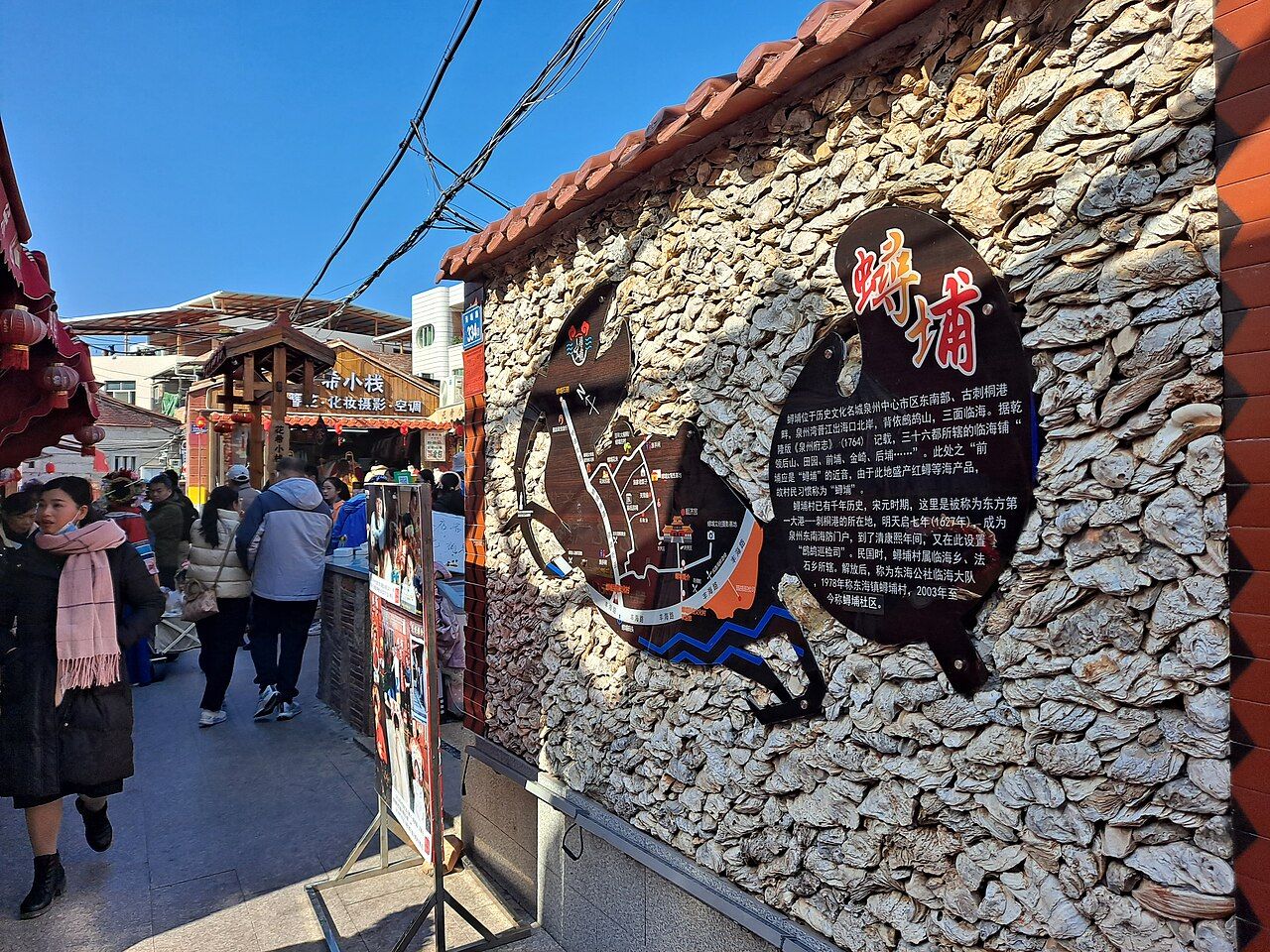
Two days. The second day leaves the old city. Xunpu village, in Fengze district about 20 minutes' drive away, is where the zeng hua wei headdress comes from — fresh flowers strung into a wreath worn with the local costume, an item on the intangible-heritage list. Expect from around ¥40 for flowers and outfit, with photography packages in the ¥250–400 range; confirm what is included before you sit down. The village also has oyster-shell walls (ke qiao cuo), a building habit left over from the Song-Yuan maritime trade. Half a day is enough.
The order matters more than the pace. Doing Tumen Street first and Kaiyuan last means finishing at the pagodas at the right hour; doing it the other way round means standing in the midday sun on an unshaded street.
The Xunpu question
The flower headdress is the reason most people go, and it is also where the day can go wrong. Cheap packages use plastic flowers, and the difference is obvious in the first photograph. Ask three things before paying: fresh flowers or plastic, make-up included or not, and whether the photographer's time is capped.
The oyster-shell walls are the part worth staying for. They are not decoration — they are what a port town built with when brick was expensive and shells were not.
Getting there and getting around
JJN is about 12 km from the city centre, roughly ¥40 and 20 minutes by taxi. High-speed rail arrives at Quanzhou station, about 20 minutes by taxi from West Street. Inside the old city, walk; where you cannot, the electric shuttle (locally called the xiao bai che) costs ¥2 a ride. Kaiyuan Temple to Tumen Street is a 15-minute walk on flat ground — a taxi is slower. Skip the three-wheelers that wave you over on the street; the fare tends to include a stop at a shop.
Timing: October to April is the window. July to September is hot and West Street has almost no shade; April brings the rain.
Two add-ons, both outside the core: the Laotse rock at Mount Qingyuan, ¥70 plus ¥15 for the shuttle, and Luoyang Bridge, a Northern Song stone bridge across an inlet, free.
Food, briefly, because it is the other reason to come: mian xian hu (rice-flour noodle soup, eaten at breakfast with fried dough), run bing rolls, shao rou zong, oyster omelette, tu sun dong, and si guo tang for the heat. West Street and Jinyu Lane have the highest density of all of it.
FAQ
Does Quanzhou old city have an entrance ticket?
No. The old city is a working district, not a gated attraction. Individually, Kaiyuan Temple, the Confucian temple and the Guanyue Temple are free, and the Qingjing Mosque is ¥3.
Is Kaiyuan Temple free, and do I need to book?
Free, but the temple asks visitors to reserve on its official WeChat account. The form is in Chinese and expects a Chinese ID number; a passport may not fit it, in which case the gate is the fallback. Hours are published inconsistently (6:00 or 6:30 opening, closing around 17:30), so check the temple's own notice that day.
Can I do Quanzhou as a half-day trip from Xiamen?
You can — the train takes about half an hour — and it is the most common way to see the city badly. Half a day covers West Street and Kaiyuan Temple and nothing of Tumen Street. One full day on foot is the minimum for the old city; two if you want Xunpu.
How much does a day in the old city cost?
Tickets: ¥3. Add lunch, coffee and the ¥2 shuttle and the day stays under ¥150 without trying. The expensive part is the hotel if you base yourself in Xiamen and commute.
Is the 240-hour visa-free transit usable here?
Yes, if you qualify. Jinjiang airport is a 240-hour transit port and Fujian is the permitted area, so transit passengers heading to a third country can leave the airport and travel within the province. Confirm your eligibility and the current rule at the airport's inbound desk — the policy is periodically revised.
What should I wear at the Qingjing Mosque?
Knees covered, shoes off inside. It is an active mosque, not a monument, and the midday prayer period is closed to visitors.
When is the best time to visit?
October to April. Late October in particular: daytime temperatures in the low twenties and little rain. July and August are punishing on an unshaded street.
What's worth booking ahead
Nothing in the old city needs booking in advance except the temple's free reservation. What is worth arranging before you arrive is a guide — the signage is multilingual, the story is not — and anything you want to pair with the same day:
Image sources: stock/library photos, credited where required.