 China Trip
Hongcun and Tachuan: Tickets and Stations
Status check (verified 2026-11-06): Hongcun is a UNESCO World Heritage site and charges ¥94 per adult. Tachuan, a working village 2.6 km away, charges ¥34–40. The Huangshan Meteorological Bureau's 2026 bulletin puts first colour around 31 October, the peak at 11–26 November, and leaf fall by the end of the month. Two high-speed stations serve the area and they are not interchangeable.
On this page
- Two villages, one afternoon, three separate tickets
- The tickets, priced
- Which station you land at decides your morning
- Yixian East: ¥13, forty minutes
- Huangshan North: ¥30–33, seventy to ninety minutes
- The window is 11–26 November, not "autumn"
- Where you sleep is a photography decision
- Fitting this into a 240-hour transit
- What this guide does not cover
Most visitors treat Yixian county as one destination with one ticket window. It is two villages with two separate ticket windows, and between them sits a variable that decides whether your photographs come out at all: which station you got off at.
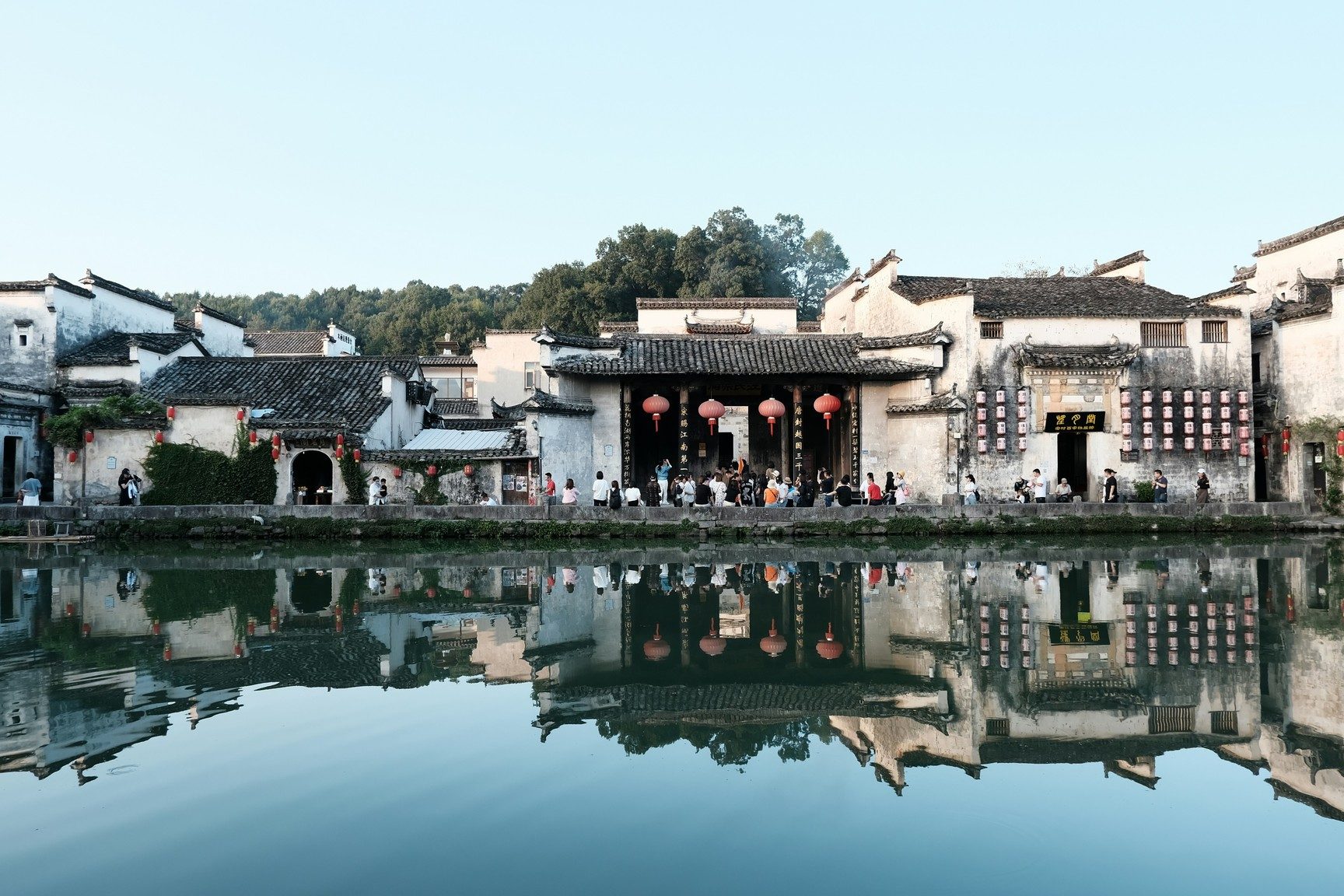
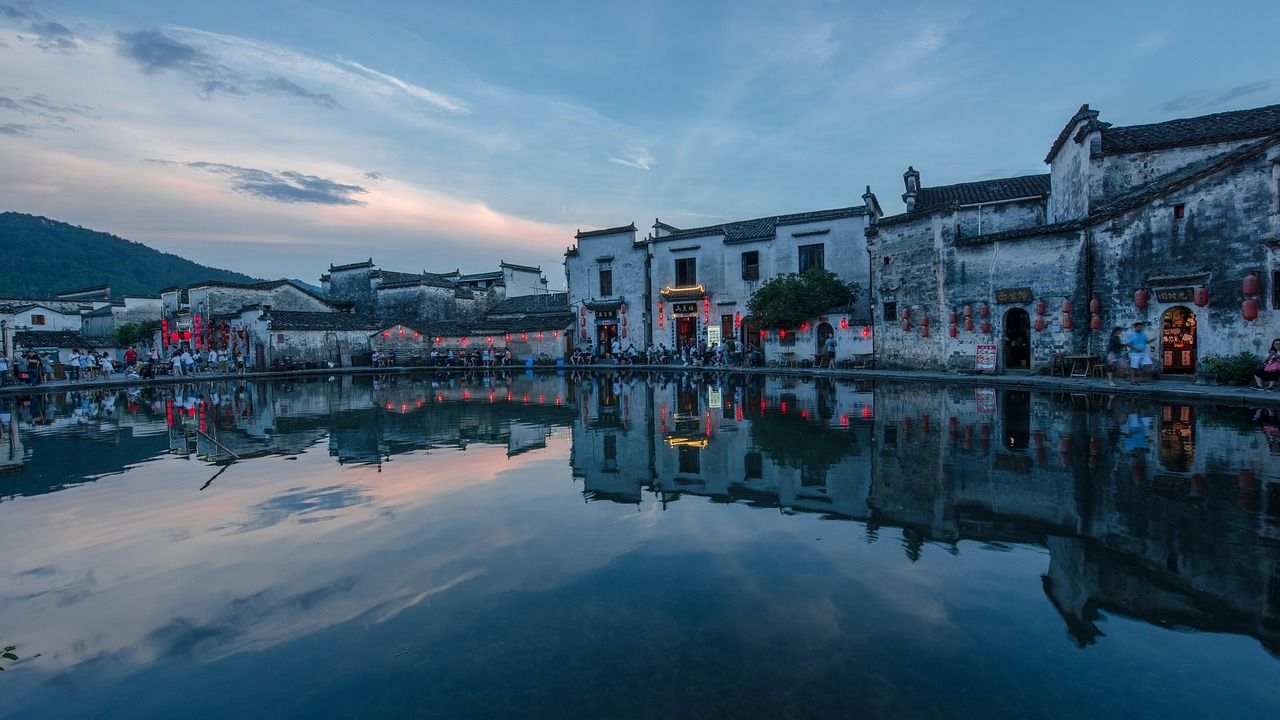
Hongcun is the one on the posters — a UNESCO World Heritage site since 2000, its lanes built around two ponds whose water system a Wang clan finished in the fifteenth century, shaping it into the outline of an ox. Tachuan is the one behind it: a hamlet on a slope, fields in front, Chinese tallow trees turning red for roughly three weeks a year. They are close enough to walk between and far enough apart that people routinely buy the wrong ticket, arrive on the wrong side, and miss the only two hours of the day that matter.
This guide prices the tickets, compares the two stations honestly, and gives you the dates the colour actually holds — not "autumn", a fortnight.
Two villages, one afternoon, three separate tickets
The first thing to unlearn is that Hongcun and Tachuan share an entrance. They do not. Each has its own gate, its own ticket office and its own price, and the only product that bundles them is a three-village pass sold as a separate item.
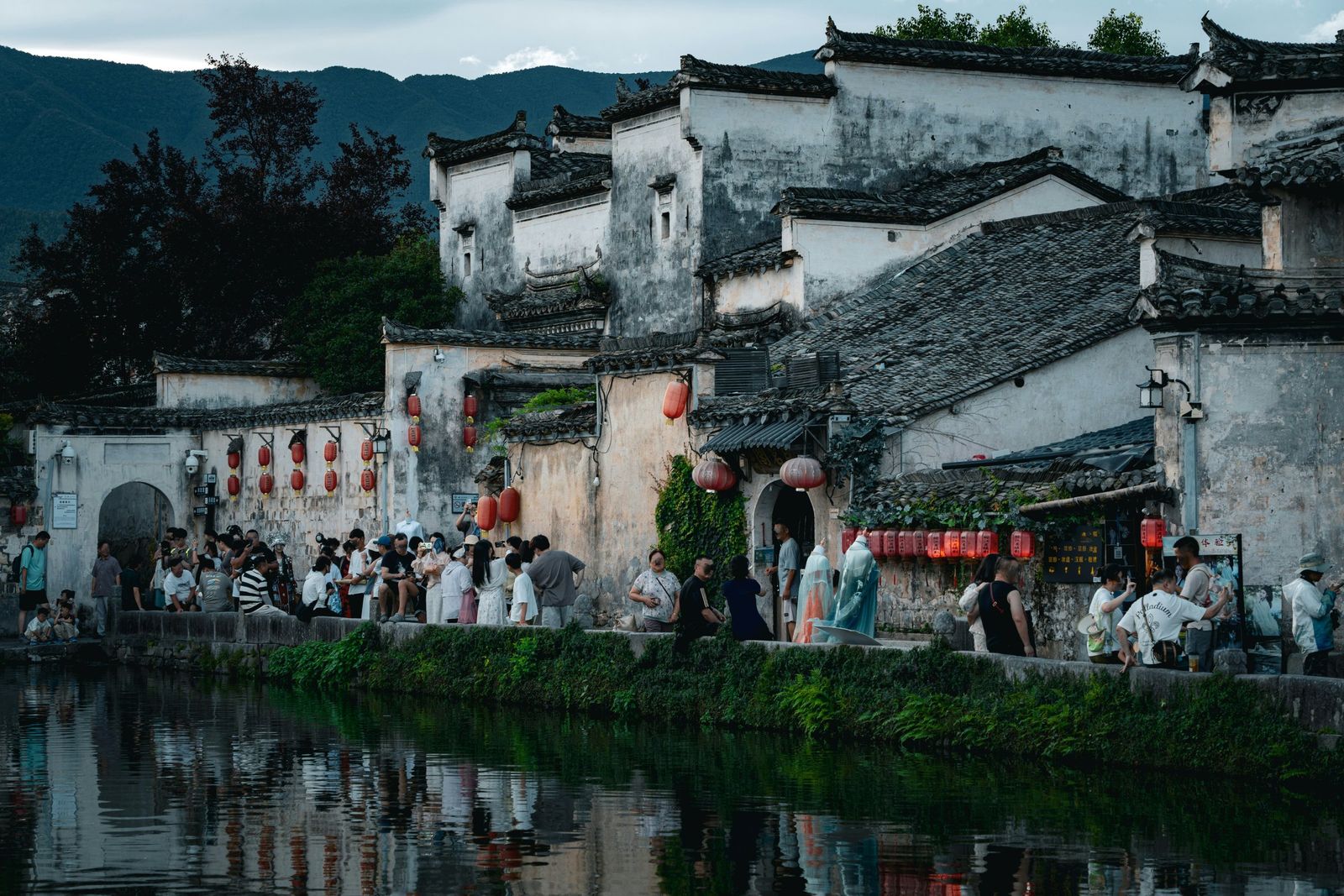
The second thing is scale. Hongcun is a walled village of a few hundred households arranged around two water bodies, and it takes two to three hours at an unhurried pace. Tachuan is a viewpoint above a hamlet; forty minutes covers the terraces, an hour covers the terraces plus the walk down. Most people do Tachuan at dawn and Hongcun from mid-morning, which is the right order — the light on South Lake hardens by late morning, and the crowds arrive from mid-morning onward.
The third thing is what you are paying for. Tachuan's fee is not an admission charge in the theme-park sense. You are paying for the maintenance of a viewing platform on the hillside outside a village that people still farm. There is no gate to walk through and nothing to queue for.
The tickets, priced
Four prices matter, and they are quoted in yuan per adult:
- Tachuan: ¥34–35 online, ¥40 at the gate. Student and senior concessions run around ¥20. The three figures disagree because they are three different channels; take the price on the page where you actually buy.
- Hongcun: ¥94. More than double Tachuan's, for a village perhaps twenty times the size.
- Seven-site pass: ¥80. Covers Tachuan, Lucun, Pingshan, Mukeng bamboo sea, the Cambrian stone forest, Wuxishan gorge and Daguling. Good value only if you are staying two nights and stringing villages together.
- Hongcun + Tachuan + Lucun: ¥148. The three-village combination, sold as its own product rather than as an add-on at either gate.
In one line: Tachuan alone ¥34–40; Tachuan plus Hongcun about ¥130; three villages on the ¥148 pass. If you are here for a single morning, buy single tickets — the passes only pay off from the second village onward.
One planning note that costs people money: the ¥80 seven-site pass does not include Hongcun, because Hongcun is not one of the seven. Anyone assuming "the pass covers everything" discovers this at the Hongcun gate.
Which station you land at decides your morning
Two high-speed stations serve Yixian, and the difference between them is not comfort — it is whether you are standing on the Tachuan viewpoint at 6:30 or still in a bus.
Yixian East: ¥13, forty minutes
Yixian East opened at the end of December 2023 with the Nanchang–Jingdezhen–Huangshan line, and the county built a transport interchange directly beside it — you walk out of the station, turn right, and you are in it.
From there, per the county government's own guidance:
- Direct shuttle to Hongcun: ¥13, about 40 minutes, 17 departures a day, first at 9:30, last at 20:50.
- Bus 10: ¥8 for the full 28 km, linking Yixian East, Xidi, Pingshan and Hongcun's bus station, roughly every half hour. Cheaper, but it stops running early — after that it is a taxi or a ride-hailing app.
The 9:30 first departure is the catch. If you want to be on the viewpoint for the mist, you need to have arrived the night before, not on the morning train.
Huangshan North: ¥30–33, seventy to ninety minutes
Huangshan North is the regional hub, with direct trains from most provincial capitals. Its tourist transport centre runs a coach to Hongcun — ¥30–33, 70–90 minutes, calling at Xidi on the way.
The trade is time and money: roughly half an hour to an hour longer and ¥17–20 more than arriving at Yixian East. Huangshan North is the correct choice if you are also doing the mountain, because the mountain's own transport hub is there. For the villages alone, Yixian East wins.
But the honest version — the part most guides skip — is that the question is not which station is better. It is whether your city has a direct train to Yixian East at all. Yixian East sits on one line; Huangshan North sits on several. If reaching Yixian East means a connection with a two-hour wait, the time you saved on the coach is already gone.
Once in Hongcun, Tachuan is another 2.6 km: a taxi for under ¥10, or county buses 1 and 4, five stops, about twenty minutes.
The window is 11–26 November, not "autumn"
Chinese tallow — the tree that gives Tachuan its colour — does not turn red on a date. It turns in stages, and the stages are triggered by night temperature:
- night minimum 12–15°C — leaves begin to yellow
- night minimum 8–12°C — leaves turn red
- below 8°C — leaves drop
The Huangshan Meteorological Bureau publishes an annual forecast on exactly this basis. For 2026 it reads: first colour around 31 October, peak viewing 11–26 November, colour holding to the end of November, then falling with the first hard frost and rain.
That is a sixteen-day peak, in a county that gets cold nights and warm days in the same fortnight. It is also why the crowd profile is so uneven: the second and third weekends of November are the busiest days of the entire year here, and a weekday in the same week is half as crowded.
Two practical consequences. Book accommodation before you book the train, because rooms inside Tachuan village are few and the peak fortnight sells out. And arrive at the viewpoint before seven, not because of tickets but because the tour groups come up from Hongcun between eight and nine.
Where you sleep is a photography decision
The single constraint that shapes the whole trip is the mist window: 6:30 to 8:00. By nine the mist has burned off and the light has gone flat. Everything about where you stay is really a question about how close you are to that ninety minutes.
- Inside Tachuan village. Village-run guesthouses, a few minutes' walk to the viewpoint, so a 5:30 start is enough. Few rooms; book early in the peak fortnight. Expect ¥200–400 for a double.
- In Hongcun. Far more choice, food at any hour, and the lanes are worth photographing after dark. The cost is a 6 am departure to cover the 2.6 km. Doubles run ¥300–800 in peak season, and the rooms on South Lake and Moon Pond — the ones everyone wants — have thin walls.
- In Yixian county town. The cheapest option by some margin, and the one that quietly forfeits the reason you came. You will not make a 6:30 mist window from there.
Two places that cost nothing and are left off most itineraries: Xieli, the terraced strip between Tachuan and Hongcun, whose colour layers are as good as the village's and which has no ticket and no crowd; and Qishu Lake, about 3 km southwest of Hongcun, where red cedars stand in the water and disappear into mist at dawn. Put Xieli in the late afternoon and Qishu Lake on a second morning, and the two free sites alone justify a second night.
Fitting this into a 240-hour transit
If you are already in China on the 240-hour visa-free transit, Huangshan is one of the ports that makes this area reachable without a separate visa — and this is the real change in how the region gets visited.
Huangshan Tunxi Airport is a designated port under the scheme. The National Immigration Administration's announcement of 17 December 2024 extended transit stays from 72 and 144 hours to 240 hours, raised the national port count to 60 across 24 provinces, and set Anhui's permitted stay area as the entire province. Enter at Tunxi, travel anywhere in Anhui, leave within ten days to a third country, and Tachuan is inside the permitted area.
All three conditions have to hold:
- your passport is from one of the 54 eligible countries
- you are in transit to a third country or region — not back to where you flew in from
- you depart within 240 hours, holding a confirmed onward ticket
The second condition is where most itineraries fail. London → Huangshan → London is a round trip, not a transit. Neither is Shanghai → Huangshan → Shanghai. What works is London → Huangshan → Bangkok, or Frankfurt → Huangshan → Seoul.
And 240 hours cannot be extended — it is ten days from entry, and the clock does not pause for a delayed flight.
One correction worth making explicitly: the Chinese state media report that prompted this guide described a 62-person foreign tour group visiting Tachuan "under the 240-hour transit policy", but did not say which port they entered through. Do not read "there are foreign groups at Tachuan" as "they flew into Huangshan". Those are two separate facts and only the first one is reported.
What this guide does not cover
- Huangshan mountain itself. The granite peak, its cable cars and its own ¥190 admission are a different trip with a different cost structure, covered separately on this site. Tachuan and Hongcun are in the valley; the mountain is a separate day trip by road, not a walk from either village.
- Getting to Yixian from outside China. There is no airport at Yixian. Everyone arrives via Huangshan North, Yixian East, or a long drive from Hangzhou or Shanghai.
- The exact price you will pay. Every figure above is a published range. Ticket platforms discount, gates do not always match the platform, and concession eligibility for foreign passports is decided at the window, not online.
- A guaranteed colour date. The bureau's forecast is a forecast. A warm October pushes everything back a week; an early cold snap strips the trees in three days.
The reason to plan this trip around a station and a fortnight, rather than around a village, is that Tachuan rewards precision and punishes general intention. Arrive in "autumn" and you will see green trees or bare ones. Arrive on the right platform on the right morning in the middle two weeks of November, and the place looks like the reason people started coming.
Hongcun's UNESCO inscription, its ¥94 admission and Tachuan's ¥34–40 are from current ticketing platforms and the county's published guidance; the seven-site ¥80 pass and the ¥148 three-village combination are separate products and neither includes Hongcun. The 2026 leaf forecast, including the temperature thresholds and the 11–26 November peak, is from the Huangshan Meteorological Bureau's Tachuan bulletin. Yixian East shuttle and bus 10 fares, frequencies and running hours are from Yixian county government's transport guidance; Huangshan North coach fares are from local ticketing platforms. The 240-hour transit rules, the 60-port list and Anhui's province-wide stay area are from the National Immigration Administration's announcement of 17 December 2024. Prices and timetables change; verify before you travel.