Pudong T2's Transit Hall Doubled — But Only for Some Tickets
Status check (verified 2026-10-26): Pudong's T2 international-to-international transit hall went from 170 to 336 square metres before the winter season that began on 25 October 2026. It now has 14 airline service counters, 3 customs temperature gates and 6 self-service border gates, and offers through-checked baggage for 10 airlines, among them Air China, Juneyao Air, Spring Airlines, Lufthansa and British Airways. The T1 hall serves five more, including China Eastern, Shanghai Airlines, Delta and Air France-KLM.
On this page
- What actually changed at Terminal 2
- The one test that decides whether this helps you
- Which terminal, and how long you need
- If you have more than four hours, leave
- What is free while you wait
- Set this up before you land
- FAQ
- Do I need to go through immigration for an international-to-international connection at Pudong?
- How much time should I leave between flights at Pudong?
- Which terminal does my airline use?
- Can I leave the airport on a long layover?
- Is the free Wi-Fi really free?
- Are there showers and somewhere to sleep?
- Does the bigger transit hall mean shorter connections?
- What's worth booking ahead
The expansion is real and it is the kind of thing that only matters to one specific traveller: the one holding a single ticket with a bag tagged to the final destination. Everyone else walks past it.
That is the whole article, really. What follows is how to work out which group you are in, and what to do with the hours either way.
What actually changed at Terminal 2
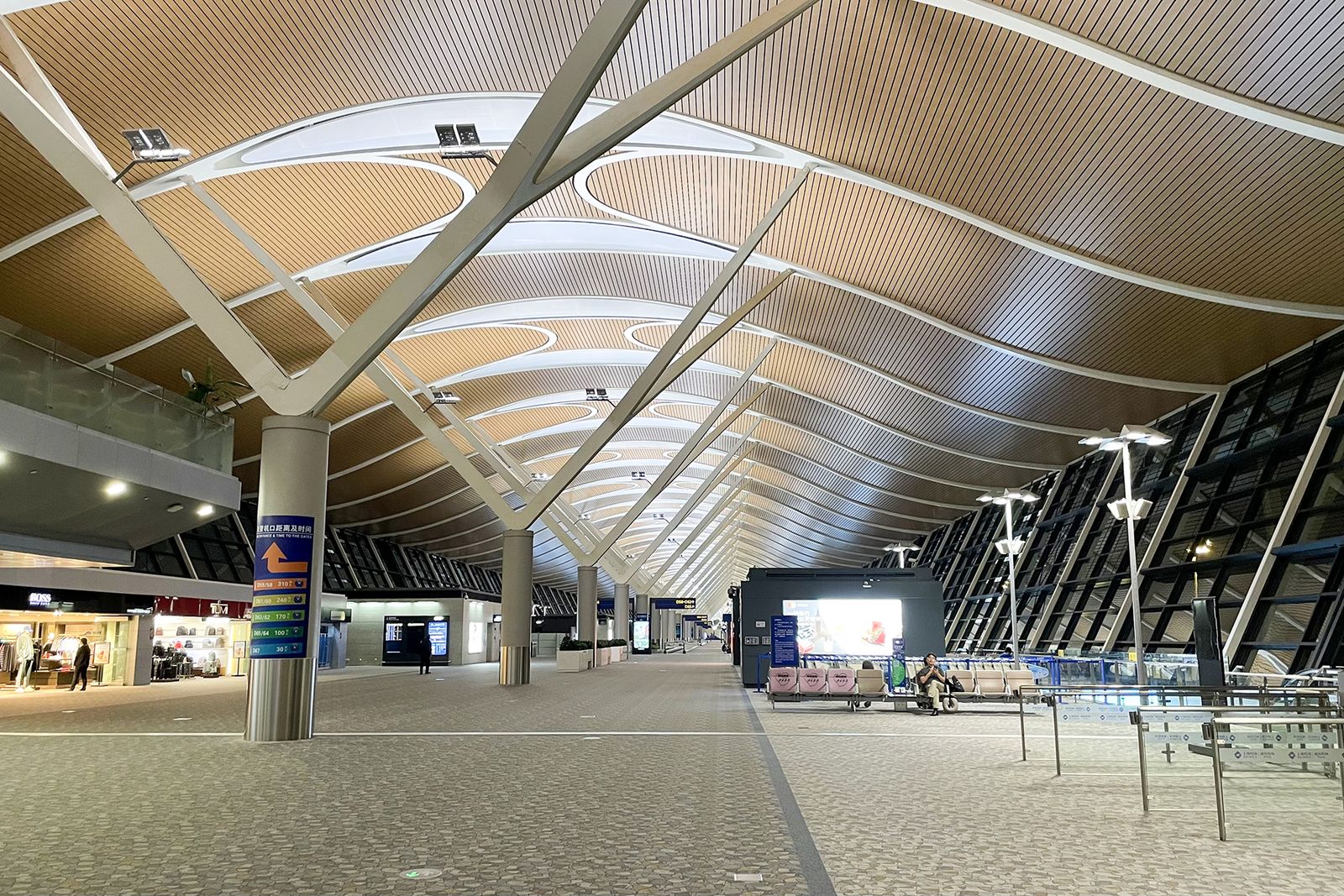
The old hall was 170 square metres. That is roughly the floor area of a large living room, and it had to absorb every international-to-international passenger changing planes at China's busiest international gateway during the same hours.
The new one is 336 square metres, and the equipment list matters more than the floor plan: 14 airline counters means an airline's own staff can reprint a boarding pass or fix a misconnected bag inside the hall instead of sending you out to the departures level; 6 self-service border gates means the document check that used to be a queue is now a scan; 3 customs temperature gates are the health screening that China kept in place after the pandemic and that still sits on the transit path.
For scale, Shanghai's two airports handle 2,511 flights a day in the 2026–27 winter season, 1,709 of them at Pudong — and Pudong moved 13.75 million transfer passengers in 2025, a transit rate of 16.2%. In April 2026 the airport's connectivity was ranked first in Asia-Pacific in ACI's index. This is not a marginal airport bolting on a service; it is a hub that has decided transfers are the product.
The one test that decides whether this helps you
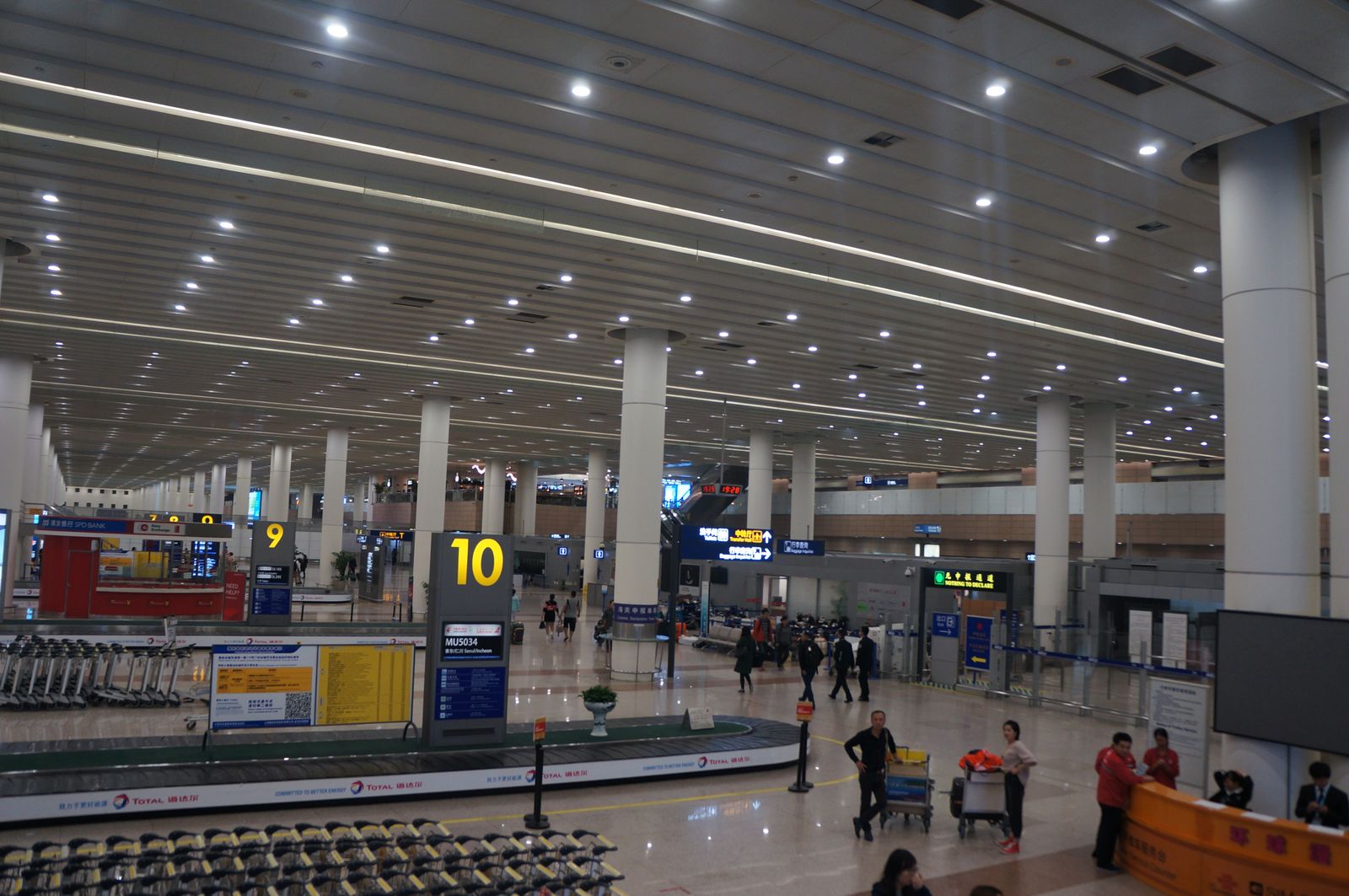
A through-checked bag is not a service the airport can give you. It is a property of your ticket.
You are through-checked if all your flights sit on one ticket — one booking reference, one ticket number — and the airlines involved have an interline or alliance agreement covering the route. Then the bag is tagged at your origin to your final destination, you never see it in Shanghai, and you stay inside the transit area the whole time. Your path is: off the plane, follow the international transfer signs, document check, a fresh security screen, up to the departure level. No immigration, no baggage hall, no re-check-in.
You are not through-checked if you bought two separate tickets, even on the same airline, even if the second leg is a codeshare. Two tickets means the second airline has no obligation to your bag and no obligation to rebook you if the first flight is late. You will collect the bag, clear immigration, walk out to the departures level, check in again and go back through security — and you will need a visa or a visa-free arrangement that lets you enter China, because you are entering.
The common trap is buying a cheap self-transfer on an online travel agent and assuming the airport will sort it out. The 336 square metres do nothing for you. The counters in that hall serve airlines with a through-check agreement; they are not a bag-transfer desk for strangers' luggage.
If you are unsure, the test is one question at check-in: "Is my bag tagged all the way through to my final destination?" If the answer is yes, the transit hall is yours. If it is no, budget for the full arrival process instead.
Which terminal, and how long you need
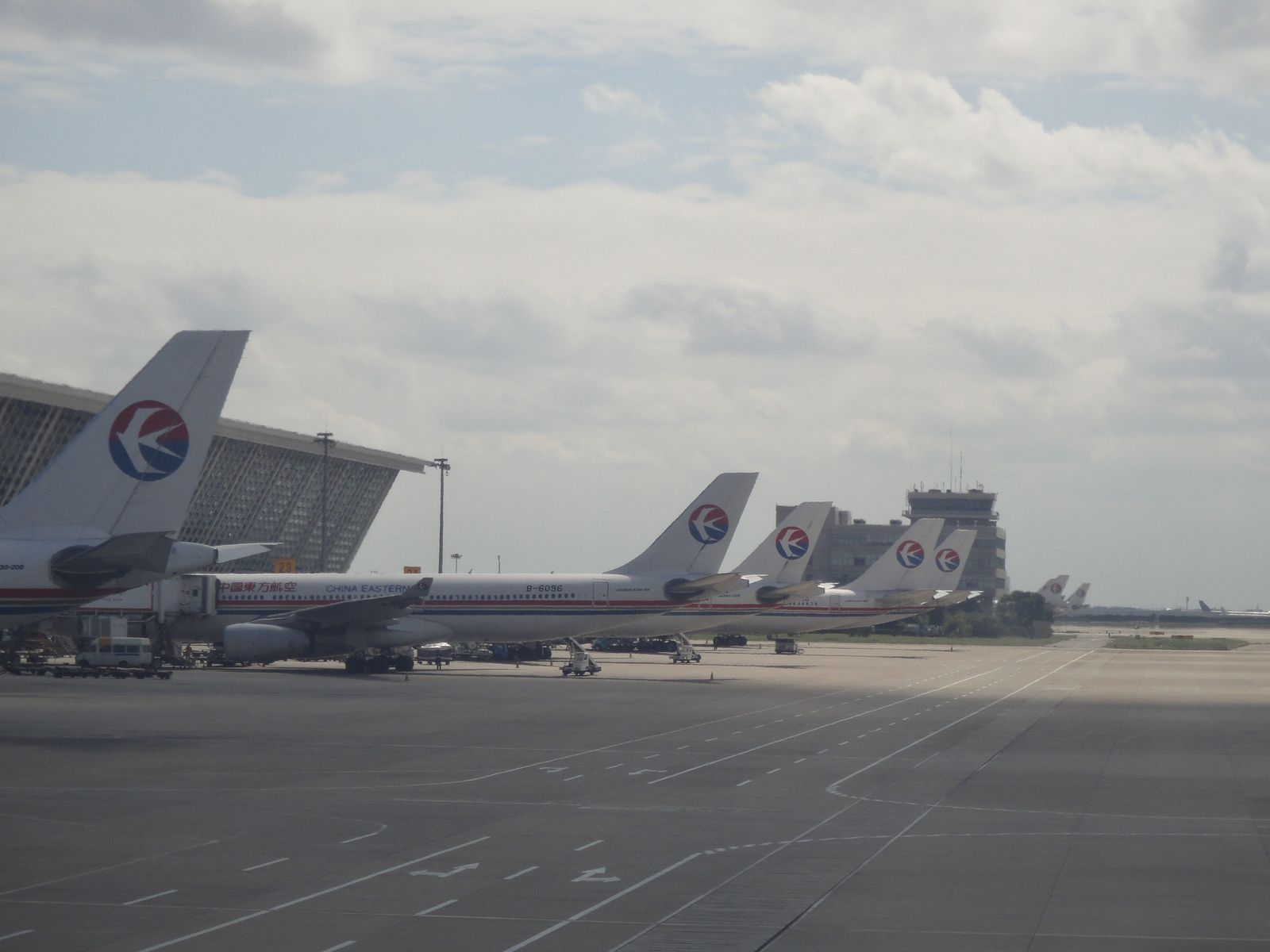
Terminal 1 is the SkyTeam side — China Eastern and Shanghai Airlines are based there, alongside Delta and Air France-KLM. Terminal 2 carries Star Alliance, Oneworld and most other international carriers. Check the terminal on your booking rather than on a blog: airline allocations move when seasons change, and the airport's own list of through-check carriers is revised without much fanfare.
The terminals face each other across the Maglev and metro station, joined by an indoor walkway of roughly 500 metres — 10 to 15 minutes on foot, or a free shuttle bus every 10 minutes outside the departures level. Two satellite concourses, S1 and S2, sit across the apron and take a large share of international boarding; an automated people mover connects T1 to S1 and T2 to S2 in about two minutes, and it stops running late at night.
The published minimum connecting time for an international-to-international transfer across terminals at Pudong is 120 minutes, and unlike the equivalents at some European airports, that figure is not padded. Same-terminal transfers use a dedicated channel and are tighter — China Eastern has cut its Pudong MCT from 90 minutes to 80. Both numbers assume your inbound flight is on time.
Two things eat the margin. First, most foreign nationals clear fingerprints at a self-service kiosk before they reach an officer, and at a peak arrival bank the combined queue can run past an hour — which is fine if you are staying airside and irrelevant if you are not. Second, gates at Pudong close early and without sentiment.
Practical answer: two and a half hours for a same-terminal through-check, three and a half if you are changing terminals, and never book the published minimum on a self-transfer.
If you have more than four hours, leave
Here is the part most transit passengers miss. China's 240-hour visa-free transit does not require you to stay in the airport, and Shanghai is one of the easiest places in the country to use it.
As of 20 August 2026 the policy covers 57 nationalities, and entry is permitted at 65 open ports across 24 provinces — Pudong among them. You need a passport valid for at least three months, a confirmed onward ticket with a date and a seat to a third country or region (the origin and the destination cannot be the same country), no refusal stamp from a Chinese visa office and no record of immigration violations in the past five years. The clock starts at midnight on the day after you enter, not at the moment you land, which is how ten days becomes ten usable days.
The rule that catches people is the third-country one. London → Shanghai → London does not qualify. London → Shanghai → Bangkok does. If you are flying home the way you came, this policy is not open to you, and no amount of explaining at the counter changes it.
If you are only in the airport for under 24 hours and staying airside, you do not need any of this: 24-hour direct transit is available to all nationalities at every open port, with no permit and no application, as long as you do not leave the restricted area. Step outside and you need a temporary entry permit from the border inspection desk.
What is free while you wait
The airport has spent the last two seasons building things that cost nothing, and a long layover is a bad time to discover them by accident.
- Wi-Fi. The free network unlocks either with a Chinese mobile number or at a passport-scanning kiosk that prints a PIN. The kiosks exist in both terminals; finding one near your gate is luck, so do it on arrival rather than at boarding time.
- Three one-stop service centres across the two airports handle currency exchange, SIM cards, mobile Wi-Fi rental, transit card purchase and mobile payment setup at a single counter. Arriving with no phone data and no working payment app is a solvable problem in about fifteen minutes here.
- Showers, free, 24 hours, at Pudong; 72-hour free luggage storage and wheelchair loan at Hongqiao.
- Nine free overnight rest areas at Pudong, plus paid sleep pods and hourly rooms in the airport hotels for the 4-to-6-hour gap.
- A multilingual audio guide — nine languages, unlocked by scanning a code — that will plan a transfer route for you.
- A free half-day Shanghai tour, run by the airport for eligible transit passengers.
- Around 200 foreign-language volunteers ("Little Navigators" in the airport's own translation) stationed in the public arrival areas and at the transport hubs.
Set this up before you land
China runs on QR payments, and the gap between "the airport" and "the city" is wider than at almost any other hub.
Link a Visa or Mastercard to Alipay or WeChat Pay before you fly, at home, on a connection you trust. The setup requires passport verification and a selfie; doing it jet-lagged on airport Wi-Fi with a dying phone is the single most common way a first China trip starts badly. Once it is done, taxis, metro, convenience stores and museum ticket windows all open up at once.
Cash remains legal tender everywhere and is a reasonable backup. Foreign cards work at a good number of airport merchants and much less reliably beyond the terminal.
Two smaller things worth doing in advance: screenshot your onward boarding pass and your hotel address in Chinese characters, and check whether your airline's through-check agreement actually covers your route. The airport publishes which carriers are in the programme; the fine print on whether your pair of flights qualifies sits with the airline.
FAQ
Do I need to go through immigration for an international-to-international connection at Pudong?
No, if your bag is through-checked and you stay inside the transit area. You pass a document check and a security screen, then go straight up to the departure level. If you hold two separate tickets, you are entering China: immigration, baggage reclaim, customs, re-check-in, security again.
How much time should I leave between flights at Pudong?
The published minimum for an international-to-international transfer across terminals is 120 minutes; same-terminal connections are tighter, and China Eastern now runs an 80-minute MCT at Pudong. Those are floor values for on-time flights. Two and a half hours same-terminal, three and a half across terminals, is a working rule for a through-checked itinerary.
Which terminal does my airline use?
Terminal 1 is the SkyTeam base — China Eastern, Shanghai Airlines, Delta, Air France-KLM. Terminal 2 carries Star Alliance, Oneworld and most other international carriers. Confirm on your booking; the airport's carrier lists change with the season.
Can I leave the airport on a long layover?
Yes, under the 240-hour visa-free transit if your nationality is on the list (57 countries as of 20 August 2026) and you hold a confirmed onward ticket to a third country or region. Flying back to where you came from does not qualify. Under 24 hours and staying airside, no permit is needed at all.
Is the free Wi-Fi really free?
Yes. It unlocks with a Chinese mobile number or by scanning your passport at a kiosk, which prints a PIN. No purchase, no time limit worth worrying about on a normal layover.
Are there showers and somewhere to sleep?
Pudong has 24-hour free showers and nine free overnight rest areas, plus paid sleep pods and hourly rooms in the airport hotels. Hongqiao handles luggage — 72 hours, free — if you would rather travel light into the city.
Does the bigger transit hall mean shorter connections?
Only if your bag is tagged through. The hall removes queueing for document checks and gives airline staff a place to fix a problem airside. It cannot turn two separate tickets into one, and it cannot make a late inbound flight on time.
What's worth booking ahead
Nothing in this guide needs booking. What is worth arranging before you fly is the payment app, a screenshot of your onward boarding pass, and — if you plan to use the 240-hour rule — a printout of your onward ticket showing the date and the seat, because that is the document the border officer will ask for.
Image sources: stock/library photos, credited where required.