 China Trip
Hohhot's Airport Moved Overnight: What Changes for Your Trip
Status check (verified 28 November 2026): Bai Ta International Airport is closed — it stopped handling passengers at midnight on 25 November 2026 and all civil flights now use Shengle International Airport in Horinger county. The airport is operating a phased ramp-up, not a full timetable: week one up to 156 flights a day, week two 180–186, week three 246–250, with the full winter schedule from the fourth week. International flights are limited to six routes. Ground transport runs, but the metro does not reach the new site.
On this page
- The short answer
- Same three letters, a different building
- Where Shengle sits, and why the ride is now the plan
- Getting into town: ¥25, ¥5, ¥50, and the one that needs a Chinese app
- The first four weeks are not a normal timetable
- Six international routes, eleven international gates
- A long layover is no longer a city visit
- What the old airport was named after
- Practical notes for an inbound trip
- What's worth booking ahead
The short answer
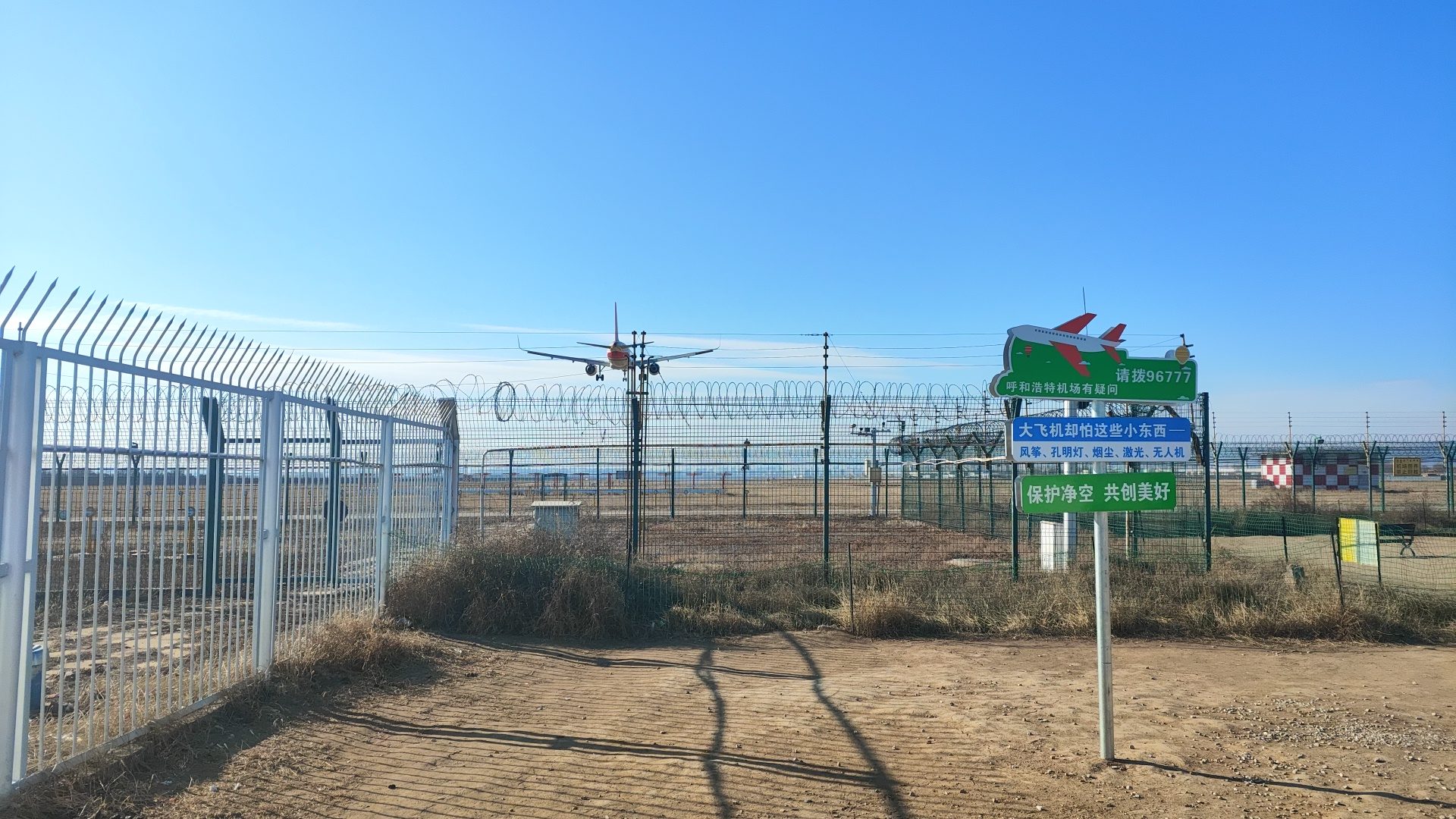
On the night of 25–26 November 2026, Hohhot swapped airports. The 68-year-old Bai Ta International Airport — 2.6 km from the edge of the built-up area, and for years the thing blocking the city from expanding east — closed at midnight. Everything moved in one go to Shengle International Airport, about 40 km away in Horinger county.
Two things follow, and only one of them is obvious.
The obvious one: your transfer to the city takes much longer. The airport express bus is 45 to 80 minutes, a taxi is a real taxi ride rather than a ten-minute hop, and the old trick of landing, dropping a bag and walking into town in the afternoon no longer works.
The one that catches people: nothing in your booking changes. The three-letter code is still HET, the ICAO code is still ZBHH, and every confirmation you already hold looks perfectly correct. If you booked a hotel near the old airport, or a driver was told "the airport", or you planned to kill a five-hour layover at Dazhao temple, those plans were written for a building that no longer takes passengers.
Same three letters, a different building
The airlines kept the code. That is deliberate — nobody wants to reprint every schedule — and it means the code tells you the city, not the airport.
What actually changed is everything the code does not describe. Bai Ta handled 13.17 million passengers in 2024 against a terminal designed for three million, four times over. It sat close enough to the city that flight paths crossed built-up districts, and there was no space left to expand in place. After years of studying an on-site rebuild and a joint Hohhot–Baotou–Ordos airport, the decision was to move the whole thing.
Shengle is a different class of building: 4F, the top category in China's airfield classification, which is the rating that means an A380 can use it. Two independent parallel runways of 3,800 m and 3,400 m, 2,000 m apart, 130 aircraft stands, a 320,000 sq m terminal — roughly three times the old one — and a design capacity of 28 million passengers and 320,000 tonnes of cargo a year. The terminal roof is shaped as a saddle, which is the one piece of local styling in an otherwise very functional building.
For a passenger, the useful numbers are smaller. Four check-in islands, 98 counters, 45 self-service check-in machines and 42 new self-service bag-drop machines, which together make self-service 63% of all check-in capacity. Face recognition is in use: once your identity is verified at a machine, the airport says you can check in by face for the next three months without producing the ID again. Security has more than 40 lanes, millimetre-wave body scanners and automatic tray return.
65 boarding gates, of which 11 are international. That ratio is the honest summary of what this airport is: a big domestic hub with a small international doorway.
Where Shengle sits, and why the ride is now the plan
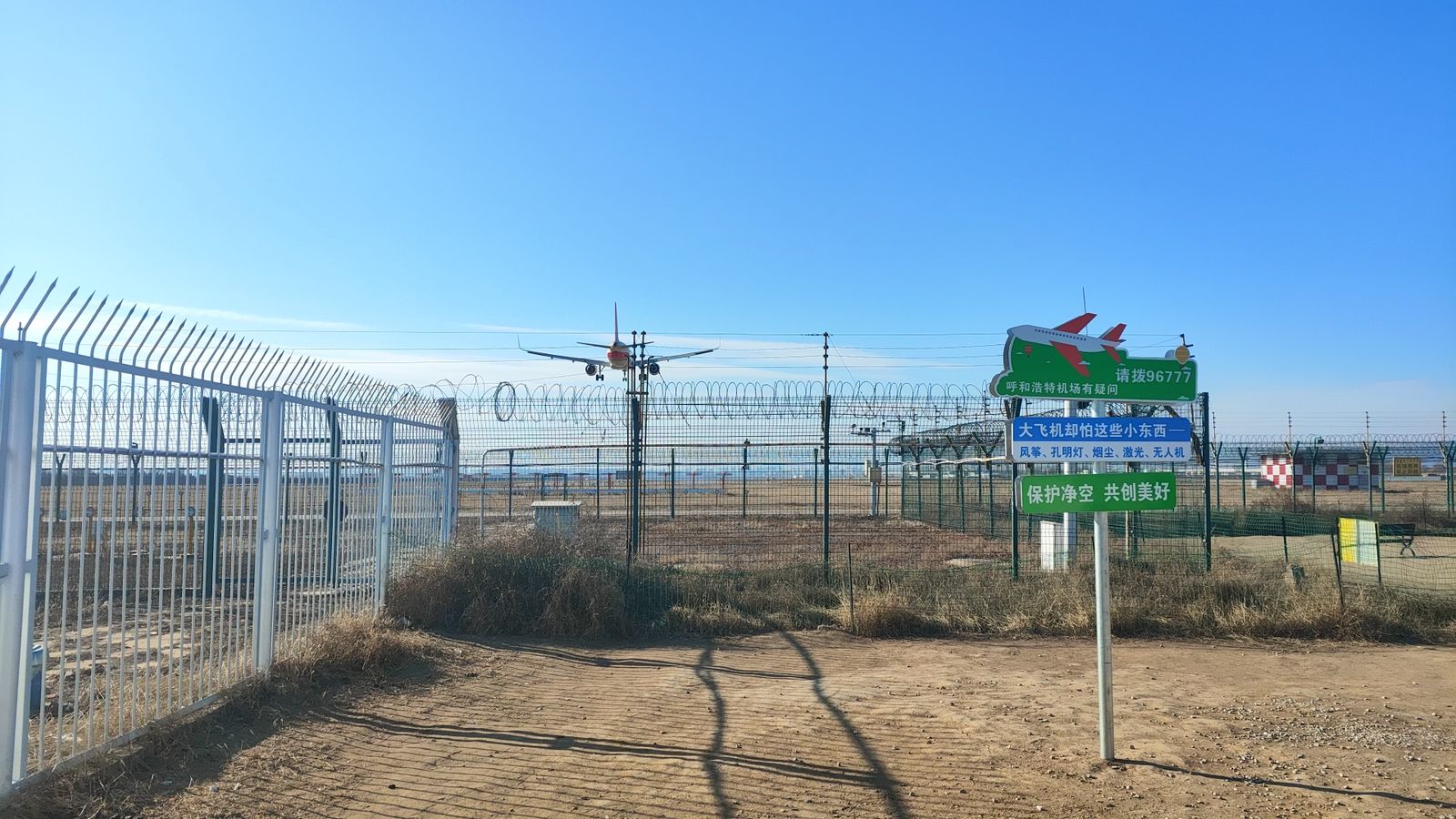
The airport is in Qiaoshiying town, Horinger county, south-east of the city. Published distances differ — 38.5 km in the airport's reference entry, 42.4 km in reporting on the move — and either figure means the same thing in practice: budget 45 minutes to an hour and a half between the terminal and central Hohhot, depending on how you travel and when.
The old airport's problem was geometry. Bai Ta's nearest boundary was 2.6 to 2.7 km from built-up Hohhot; the city grew around it, and noise, obstacle limitation and airspace conflicts grew with it. Shengle was built out on the plain with room for two full runways and a second phase of growth, which is why the drive is long. There is no version of this where the airport stays convenient and the city gets its space back.
Practical consequence: the airport is no longer a place you pass through on the way to something else. It is a leg of the journey, and it needs to be on the itinerary with a time attached.
Getting into town: ¥25, ¥5, ¥50, and the one that needs a Chinese app
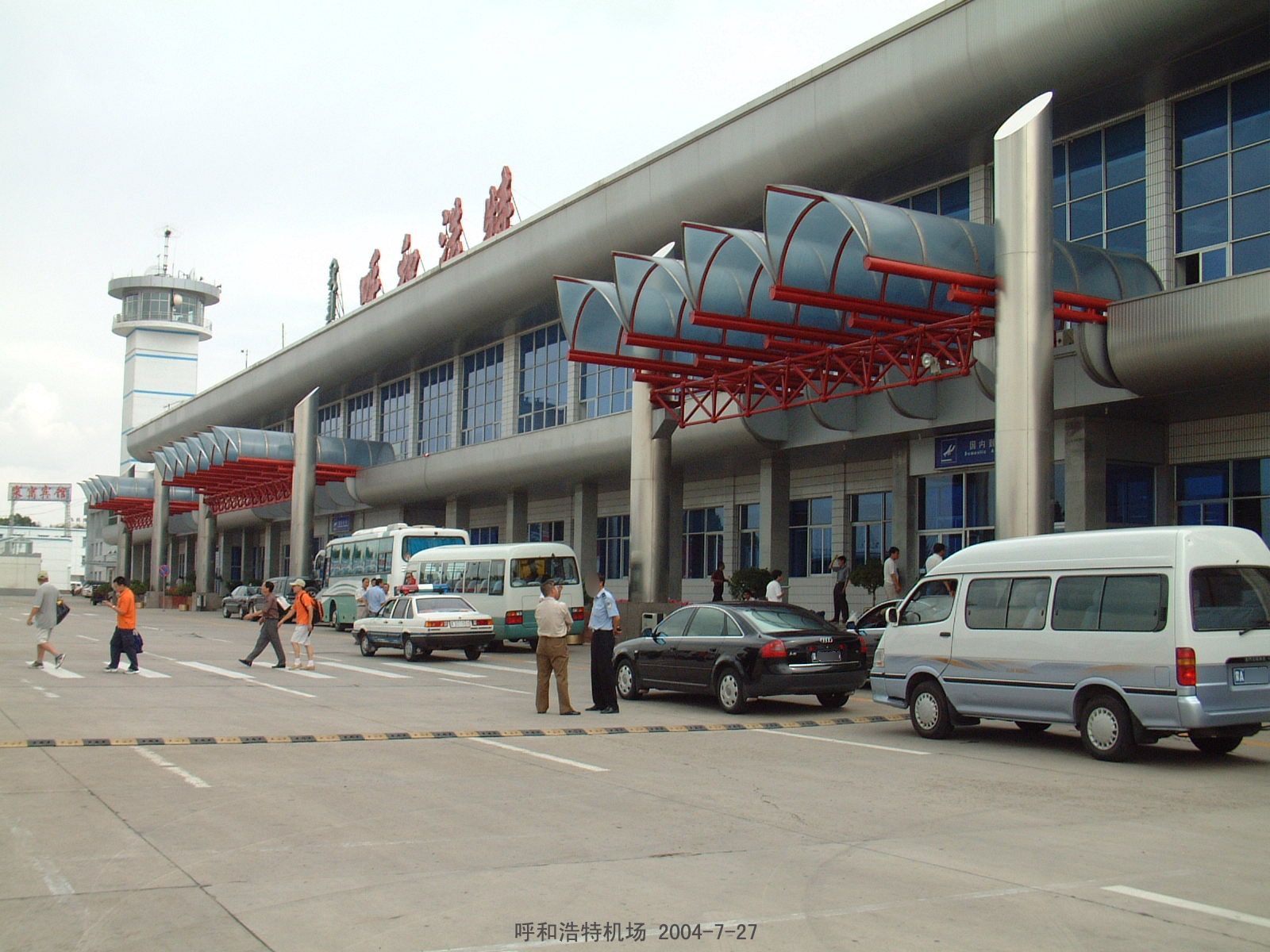
The airport publishes five ground options. They are not equivalent, and two of them are hard to use without a Chinese payment app or phone number.
Airport express bus — ¥25. Four lines from four fixed downtown stops: Hohhot East Railway Station, Hohhot Railway Station, Jinchuan, and Lamaying station on metro line 2. Journey 45 to 80 minutes, buses leave when full, and the service follows the flight schedule, including late arrivals. This is the option to default to: fixed price, fixed stops, no app, no Chinese.
City bus — ¥5. Routes 101, 35 and 209 run to the Shengle management committee, where a free shuttle completes the trip; express routes 125, 127 and 128 go direct. Cheapest by a distance, slowest by a distance, and the signage and on-board announcements are in Chinese, so it suits a traveller who is comfortable being slightly lost.
Custom shuttle — ¥50. Nine-seat cars, every 15 minutes, door-to-door pickup, booked through a WeChat mini-programme. Good value if you can use it; the booking step is the barrier.
Taxi — metered. The rank is at the arrivals exit. Expect the meter to run for the full distance; this is now a genuine suburban transfer, not a city hop.
Ride-hailing — set your pickup point. Cars do not meet you at the terminal door. The designated pickup area is in the car park, level B1, south zone C — the airport describes it as passengers finding the car, not the car finding the passenger. If you order a car and stand at the kerb, you will watch it circle.
Driving yourself: the S43 airport expressway gets you there in about 40 minutes from the centre in good conditions; the toll is ¥11 one way for cars up to nine seats. Parking is 1,998 spaces: first 30 minutes free, then ¥2 per 30 minutes for the first hour and ¥3 per 30 minutes after, capped at ¥60 for the first day and ¥70 a day from the second.
One trap worth naming. The metro does not serve Shengle. Line 2 connects to the express bus at Lamaying, and that is the whole of the rail connection for now. Line 1 has a station whose name still carries "(Airport)" — it was built for Bai Ta and it is not a route to the new field. If a map app sends you there with your luggage, it is working from an old assumption.
The first four weeks are not a normal timetable
This is the part most travel writing will get wrong, because it is temporary and it changes weekly.
The move was deliberately staged. Bai Ta wound down to 126, then 117, then 56 flights a day before closing. Shengle ran 40 flights on day one — Beijing, Guangzhou, Shenzhen, Shanghai, Hangzhou, Chengdu, Chongqing, Zhengzhou, plus eight airports inside the region — and then ramped: up to 156 flights in week one, 180 to 186 in week two, 246 to 250 in week three, with the full winter schedule from week four.
The cuts were concentrated on cities that high-speed rail already serves. Three corridors never stopped: the Pearl River Delta, the Yangtze River Delta and the Chengdu–Chongqing axis, at 21, 11 and 8 to 9 daily flights respectively this winter. New domestic points were added at the same time, including Lhasa, Beihai and Xishuangbanna.
When the ramp finishes, the winter season is planned at 31 airlines, 292 flights a day and 56 cities. Until then, treat any schedule as provisional. The airport's own guidance is blunt about the upside: if an airline cancels or changes your flight, you can rebook or refund free of charge — and during a ramp-up, changes are more likely than usual. Watch for the airline's message rather than assuming the booking is stable.
Six international routes, eleven international gates
If you are flying in from abroad, the list is short and specific. As of 27 November, Hohhot's port runs six international and regional routes: Ulaanbaatar in Mongolia; Busan, Incheon and Daegu in South Korea; Vladivostok in Russia; and Hong Kong. Hohhot–Ulaanbaatar keeps 12 flights a week, which makes it the busiest of the six.
The first international departure from the new terminal was Air China CA757 to Ulaanbaatar on the morning of 27 November. The port handled a little over 120,000 passengers this year — small, but it is the only open port in the Hohhot area of the free-trade zone, and the airport has been built with room to add routes toward Russia, Mongolia, Japan, Korea and South-East Asia.
Immigration has been rebuilt rather than moved: 32 channels in the new hall — on departure, 8 staffed and 6 e-channel; on arrival, 10 staffed and 8 e-channel — with a single-stop inspection model the airport calls one machine, two screens. The e-channels read your travel document and compare fingerprint and face, which takes about ten seconds. For a passport holder from a country eligible for visa-free entry, this is the fastest part of the journey; the slow part is the 40 km afterwards.
Two timing notes. The airport asks for two hours before a domestic flight and three before an international one — a 320,000 sq m terminal with 130 stands is not quicker to walk than the small building it replaced, and the first weeks are still bedding in. And check which visa or visa-free arrangement you are actually entering under before you book: the visa-free list, the 240-hour transit scheme and regional arrangements have different nationality and port conditions and are revised without much notice.
A long layover is no longer a city visit
This is the change that has quietly removed an option from Hohhot itineraries.
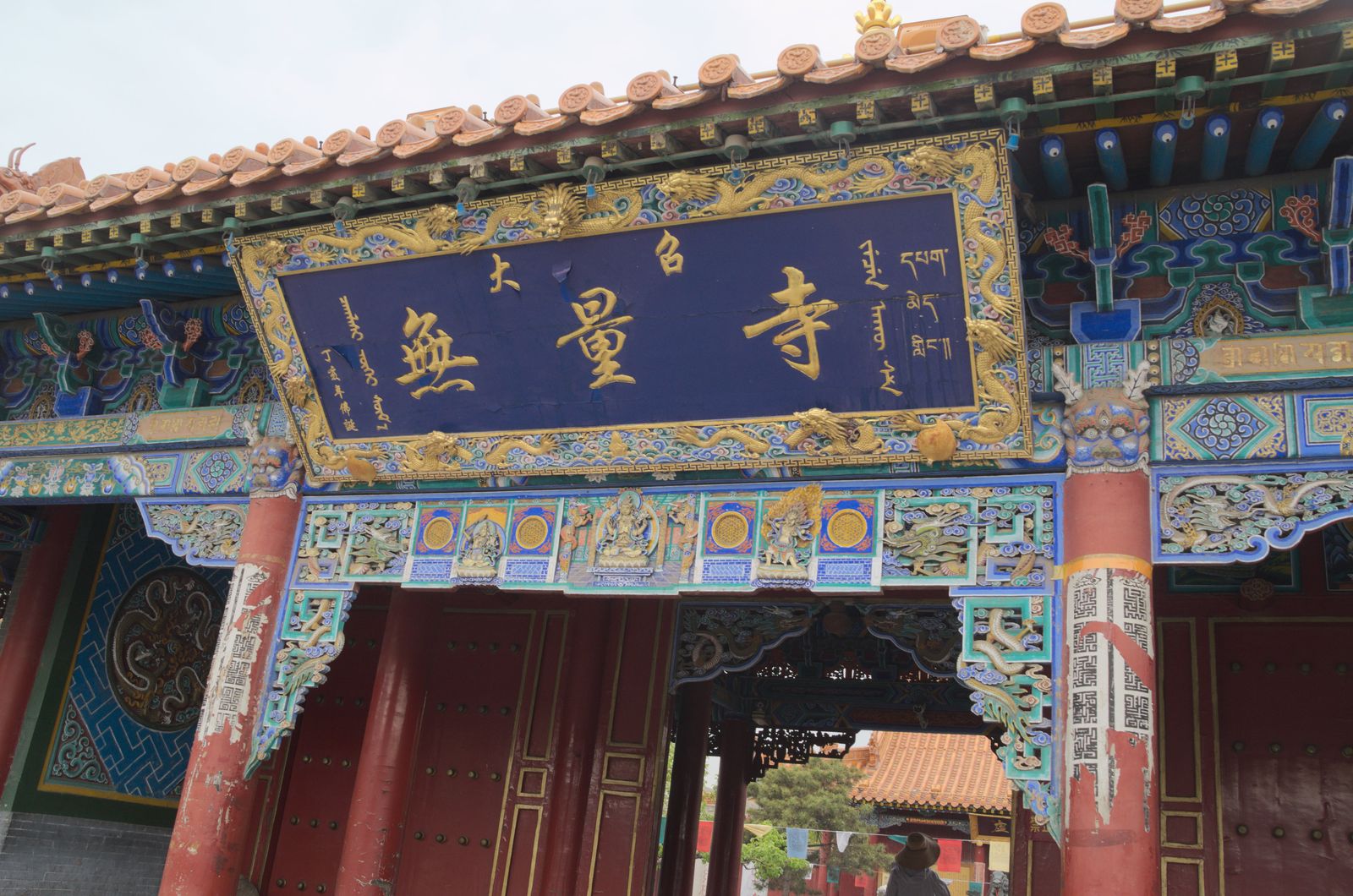
Bai Ta was close enough that a five-hour gap between flights could mean a taxi into town, an hour at Dazhao temple or the old street around it, and back with time to spare. Shengle cannot support that. With 45 to 80 minutes each way and a three-hour check-in buffer for international departures, a five-hour layover is now a wait at the airport, not a visit to the city.
If you want Hohhot itself — Dazhao's silver Buddha and its multilingual sign, the Five Pagoda temple, the museum with the dinosaur halls, the milk-tea and lamb of the old town — give it a night. The city's own draw is real; it just needs to be a stop rather than a gap.
The same logic applies to grassland trips. The steppe most visitors picture, an hour or two out of the city, is now two hours out of the airport before you start. Operators running day trips from Hohhot have had to rebuild their pickup times this month, and the honest question to ask when booking is not "how far is the grassland" but "what time do you collect me, given where the airport is now".
What the old airport was named after
Bai Ta means white pagoda, and the airport took the name from a real one: the Wanbu Huayanjing pagoda, a Liao-dynasty brick tower about 55 m high, standing a few kilometres from where the runways were. It is whitewashed, octagonal, seven storeys, and its inner walls carry inscriptions in Chinese, Tibetan, Khitan, Jurchen, Mongolian and Old Uyghur — the script layers of a city that has been a border capital for a thousand years. It has been on the national key heritage list since 1982.
The airport opened on 1 October 1958 with a single dirt runway and closed with 13 million passengers a year. It is not being demolished: the 4E runway, the air traffic facilities and some 223,000 sq m of buildings are being kept for the low-altitude economy — test flights, drone certification, aviation training — which is a reasonable second life for a runway that a city grew around.
The pagoda is still there, and still white. It is one of the few things in Hohhot that the move did not touch.
Practical notes for an inbound trip
Re-check the airport name on the booking, not just the city. Chinese airport names are on every ticket and every itinerary; the one you want now reads 呼和浩特盛乐国际机场, not 白塔. If a confirmation still says Baita, it was issued for a building that closed on 25 November.
Give the transfer a slot in the plan. 45 to 80 minutes by express bus, about 40 by car, and the express bus is the option that does not require a Chinese app.
Tell your hotel and your driver the terminal, not the city. Airport pickups booked before November were booked for Bai Ta's address. This is the single most common way the move will cost a foreign visitor money.
Do not build a tight connection on a domestic ramp-up schedule. For the next few weeks, flights are still being added back. If you are connecting to a grassland trip or a train, leave a night in Hohhot rather than an hour.
Keep the return leg in mind. Arriving at a new airport is easy to plan for; leaving from one at 07:00 means leaving the city at 05:00. Airport express buses follow the flight schedule, but confirm the first departure of the day for your date.
Some links in this section are affiliate links — we may earn a commission if you book through them, at no extra cost to you. Affiliate disclosure.
What's worth booking ahead
The ramp-up week you are travelling in. Week one is up to 156 flights a day; the full winter schedule arrives in week four. Schedules published now may not be the schedule you fly.
Whether the express bus stop you want is running at your hour. Four downtown stops; late arrivals are covered, early departures need checking.
Your entry category. Visa-free entry, the 240-hour transit scheme and regional arrangements carry separate nationality and port lists, and they change.
Your onward ground plan. Grassland operators, drivers and hotels have all had to re-time pickups this month; ask for the pickup time, not the distance.
👉 Check Inner Mongolia tours, Hohhot transfers and grassland day trips
Image sources: all four photographs are from Wikimedia Commons — the night kerbside and the fence-line approach shot by HCCB3947 (CC BY-SA 4.0), the 2004 kerbside by wanghongliu (CC BY-SA 3.0), the Dazhao plaque by Popolon (CC BY-SA 4.0) — and all are credited in the captions. The three airport photographs show Bai Ta, the terminal that closed on 25 November 2026; none claims to show the new Shengle terminal, which no free-licence channel covers yet. Airport codes, transfer times, tariffs and flight numbers change — confirm with your airline, the airport's own ground-transport pages and the National Immigration Administration before you travel. Last verified 28 November 2026.