 China Trip
Hong Kong Airport to Mainland China via the HZMB Bridge: How It Works
Status check (verified 2026-11-13): The route works, and it has just been used by a foreign tour group for the first time. On 12 November 2026 a Malaysian group flew out of Zhuhai Jinwan Airport to Ganzhou after entering the mainland over the Hong Kong–Zhuhai–Macau Bridge — the first time the "via Zhuhai-Hong Kong flight" product has been used for overseas arrivals rather than for Taiwan, China.
On this page
That matters for independent travellers for one reason: the route is now a documented, functioning path from an international arrival hall into China's domestic flight network. It is not a package you have to buy. It is three segments you assemble yourself, and the assembling is where people lose an afternoon.
What the route actually is
Flying into Hong Kong to reach a mainland city is an old trick: Hong Kong International Airport has far more long-haul capacity than most mainland regional airports, and a domestic connection from Zhuhai or Guangzhou can be cheaper than a connecting flight through Beijing or Shanghai.
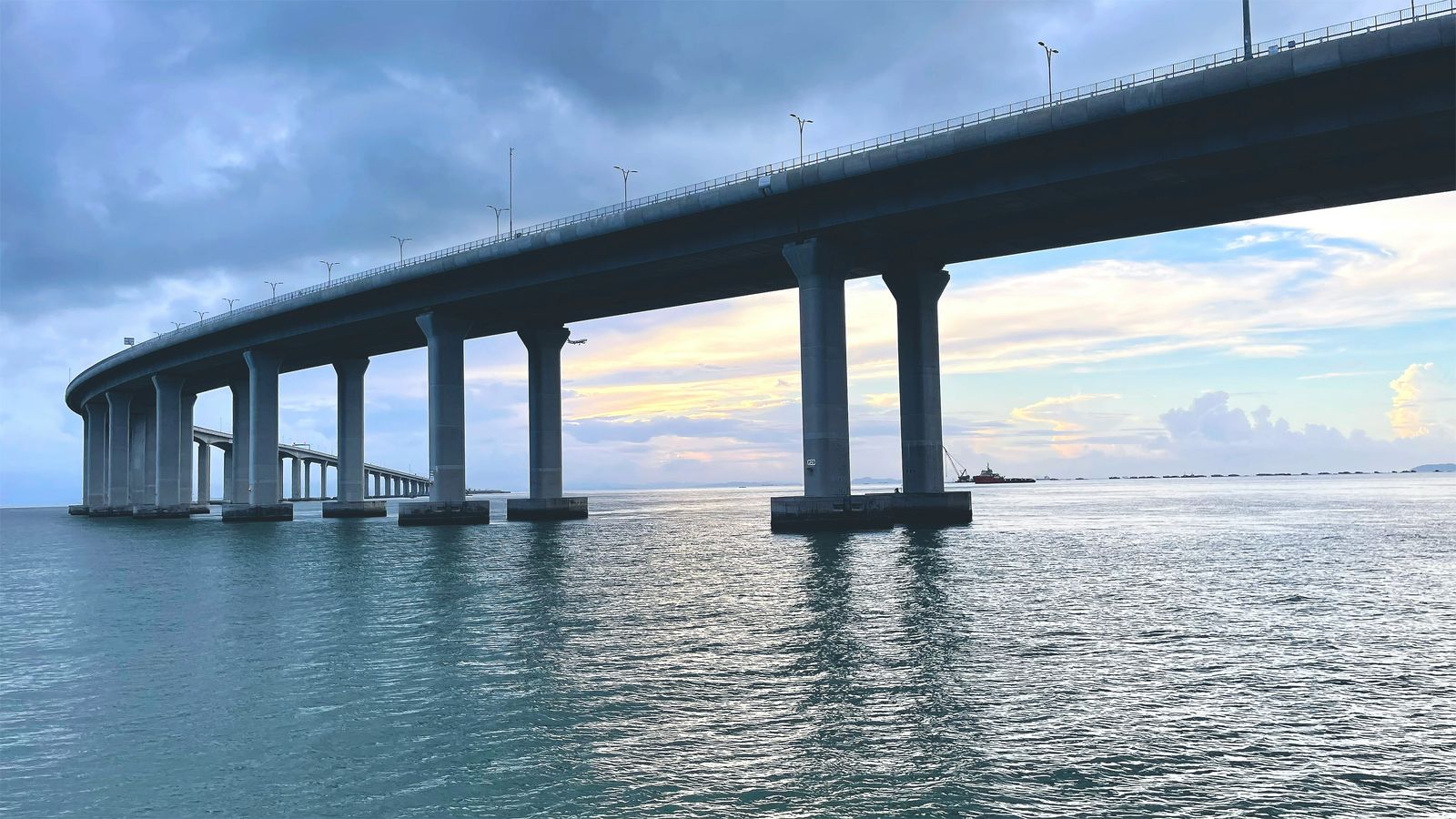
The bridge changed the geometry of that trick. Before it opened, a passenger landing at Hong Kong airport and heading for western Guangdong faced a ferry or a long detour through Shenzhen. Now there is a road crossing that starts on the same island as the airport.
The full chain looks like this:
- Segment one: Hong Kong International Airport → Hong Kong Port of the HZMB. Both sit on Chek Lap Kok, the same island. A shuttle bus covers it in about ten minutes.
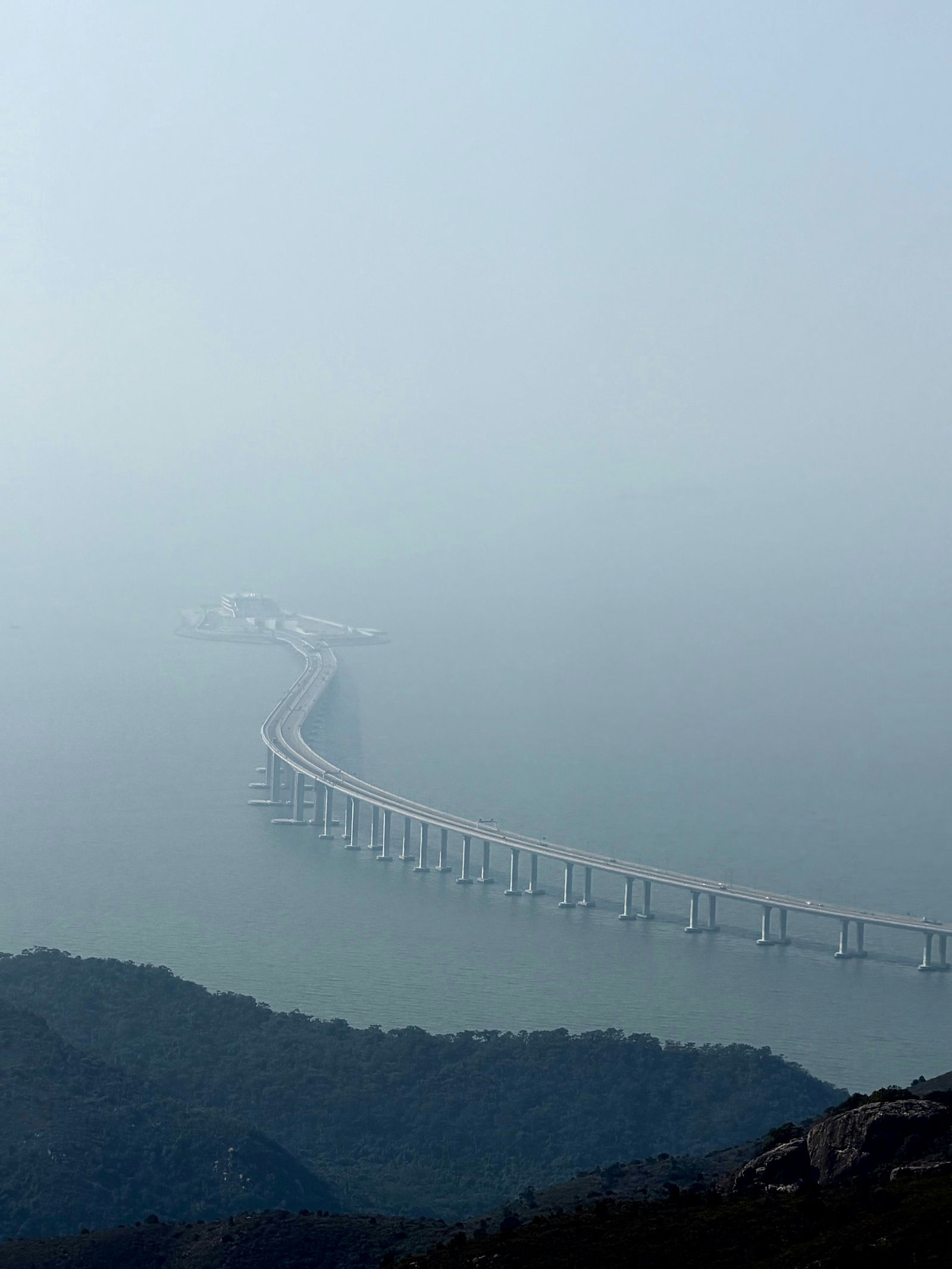
- Segment two: Hong Kong Port → Zhuhai Port, on the Golden Bus shuttle. Roughly 40 minutes across the bridge, no intermediate stops.
- Segment three: Zhuhai Port → Zhuhai Jinwan Airport, in Jinwan District, a further road journey by airport bus or taxi.
Zhuhai Jinwan is a domestic airport. That is the whole point of the route: you are trading a long-haul connection for a domestic one.
Crossing the bridge: fares, frequency and the one thing to know
The Golden Bus runs 24 hours. Headways are short in the daytime peak — around five minutes — and stretch to 15–30 minutes overnight. No reservation is needed; you turn up, buy a ticket and board.
Published fares, as recorded on 13 November 2026:
- Hong Kong → Zhuhai: HK$65 by day, HK$70 at night
- Zhuhai → Hong Kong: ¥58 by day, ¥63 at night
- Children and senior citizens pay half
The thing to know is that this is not one seamless journey with one ticket. Each segment is priced and operated separately, and the border formalities sit in the middle of it.
Two immigration checks, not one
The bridge operates on a three-location, three-check basis. For a passenger travelling from Hong Kong into the mainland, that means:
- Hong Kong exit clearance at Hong Kong Port, before boarding the bus;
- Mainland entry clearance at Zhuhai Port, after alighting.
Both are compulsory. Neither can be skipped, and they cannot be merged into one step. Signage at both ends is clear, but the sequence surprises people who assume a bridge crossing is like a road toll.
Budget for queues rather than for distance. The 40 minutes on the bridge is the predictable part of the day.
The bridge is not a visa workaround
This is the point most likely to ruin a trip, so it is worth stating plainly: crossing at Zhuhai is a change of port of entry, not a change of entry rules.
- If your nationality needs a Chinese visa, you still need one. The bridge does not substitute for it, and there is no facility at the port to fix the problem.
- If you qualify under a unilateral visa-free arrangement, you enter on those terms as normal.
- If you are using the 240-hour transit visa-free policy, the standard conditions apply — including a confirmed onward ticket to a third country, not back to where you came from.
The last point catches people who book a return flight home and assume the transit rule will cover them. It will not. Confirm your own category against the National Immigration Administration's current notices before you book anything, because the eligible-port and eligible-nationality lists have been expanded repeatedly and they move.
What the first group actually did
The Malaysian group's itinerary, reported on 12 November 2026, is a useful template because it shows the route being used the way it is designed to be used:
- 10 November: land at Hong Kong International Airport; sightseeing at Victoria Peak and the Avenue of Stars.
- 11 November: cross the bridge into Zhuhai; a day trip from the port to Macau — Ruins of St Paul's, Travessa da Paixão, Rua do Cunha, the Venetian, "The House of Dancing Water" — and back to Zhuhai the same evening.
- 12 November: Zhuhai city sights, then fly from Zhuhai Jinwan to Ganzhou in Jiangxi, for a ten-day Guangdong–Jiangxi itinerary.
Two things are worth separating here. The route is available to anyone. The packaging is not: the group had dedicated check-in counters and staff guiding them between segments, and the through-arrangement they travelled on is a tour product. Independent travellers book each segment themselves.
That is not difficult. It does mean you should not plan on the assumption that you land and roll straight across the bridge.
How long it really takes
From touchdown at Hong Kong airport to central Zhuhai, allow two hours as a floor, and more on the day itself. The components are:
- baggage reclaim and walking to the airport's bridge-side shuttle;
- the shuttle to Hong Kong Port;
- Hong Kong exit clearance;
- waiting for the Golden Bus, and the 40-minute crossing;
- mainland entry clearance;
- the road leg into the city, or onward to Jinwan Airport.
Add to that the fact that Jinwan Airport is not in the city centre — it is a further run south-west across Jinwan District. If you are connecting to a domestic flight, work backwards from the flight time and check the airport bus schedule for the day rather than assuming a frequent service.
Holidays distort everything. Around Spring Festival and the October national holiday, both ports and the bus queues behave like a different system.
Who this suits, and who should fly direct
It suits you if:
- your destination is in western or southern Guangdong, or you were going to stop in Hong Kong or Macau anyway;
- you found a long-haul fare into Hong Kong that is materially cheaper than flying into a mainland hub;
- you are carrying light luggage and are comfortable assembling three separate bookings.
It does not suit you if:
- your final destination has frequent direct flights from a mainland hub — you would be adding a border crossing to save a connection;
- you are travelling with children, elderly parents or a lot of luggage and would rather not handle three handovers;
- your nationality needs a Chinese visa and you have not got one. The bridge will not help, and Zhuhai Port is not the place to discover that.
The economics are simple: the bridge crossing and the airport shuttle are cheap. What you are paying with is time and handovers. Whether that is a good trade depends almost entirely on where you are going next.
Some links in this section are affiliate links — we may earn a commission if you book through them, at no extra cost to you. Affiliate disclosure.
What's worth booking ahead
The bridge runs around the clock and needs no booking. The parts that need planning are the two ends: the domestic flight out of Zhuhai Jinwan, and the road leg between the port and the airport. Both are easier to arrange before you fly than on the day, and the airport bus timetable is the piece most people leave to chance.