Furong Town vs Fenghuang: One Charges at the Gate, One Doesn't
The short answer: Fenghuang's old town is free to walk into, at any hour. Everything inside it — the nine historic sights, the river boats — is priced separately and entirely optional. Furong Town works the other way round: a ¥108 gate ticket (from ¥100 online) buys the whole town, waterfall included, and there is no free way in. The two are 33 to 40 minutes apart on the same high-speed line. The real question is not which one to see, but which one to sleep in.
On this page
They get compared because they are the same shape on a map: two small towns in Xiangxi Tujia and Miao Autonomous Prefecture, in the far west of Hunan, both built of dark timber stilt houses on a river, both about an hour from Zhangjiajie, both now on the same rail line. Travellers with three days in the region routinely try to do both and end up doing neither properly.
They are not the same shape in practice. One is a walled, ticketed 4A scenic area with a single headline sight. The other is a working county town whose historic core costs nothing to enter and whose appeal is diffuse — a river, a row of houses, a morning mist, a bowl of noodles.
One charges at the gate, one doesn't
| Furong Town (芙蓉镇) | Fenghuang (凤凰古城) | |
|---|---|---|
| Entrance | ¥108 gate price, ¥100 online, includes the folk performance | Free, 24 hours |
| What the ticket covers | The whole old town, the waterfall, the performances | Nothing — the streets only |
| Optional add-ons | Rafting (~¥198), Lao Sicheng ruins (¥118) | Nine-sight pass (¥128), river cruises (¥68–148), Nanhua Mountain (¥88) |
| Hours | 08:00–24:00 | Streets always open; ticketed sights 08:00–17:30 |
| Best hour | 19:30, when the waterfall is lit | 06:30, before the town wakes up |
| Sleeping there | Cliff-side rooms facing the waterfall | Riverside stilt houses on the Tuo |
This is where most English-language planning goes wrong, and the reason is historical. For a few years in the mid-2010s Fenghuang did charge one combined entrance ticket for the old town. That was abolished, and the nine-sight pass took its place. A large amount of the advice still circulating — including some that ranks well — was written during that window and describes a town that no longer exists. If a guide tells you Fenghuang charges a single entrance ticket covering the whole old town, it is describing a policy that ended years ago.
Furong Town has never had that reversal. Its ticket is real, it is checked, and the thing you came to see is behind it.
Furong Town: the waterfall is inside a ticket gate
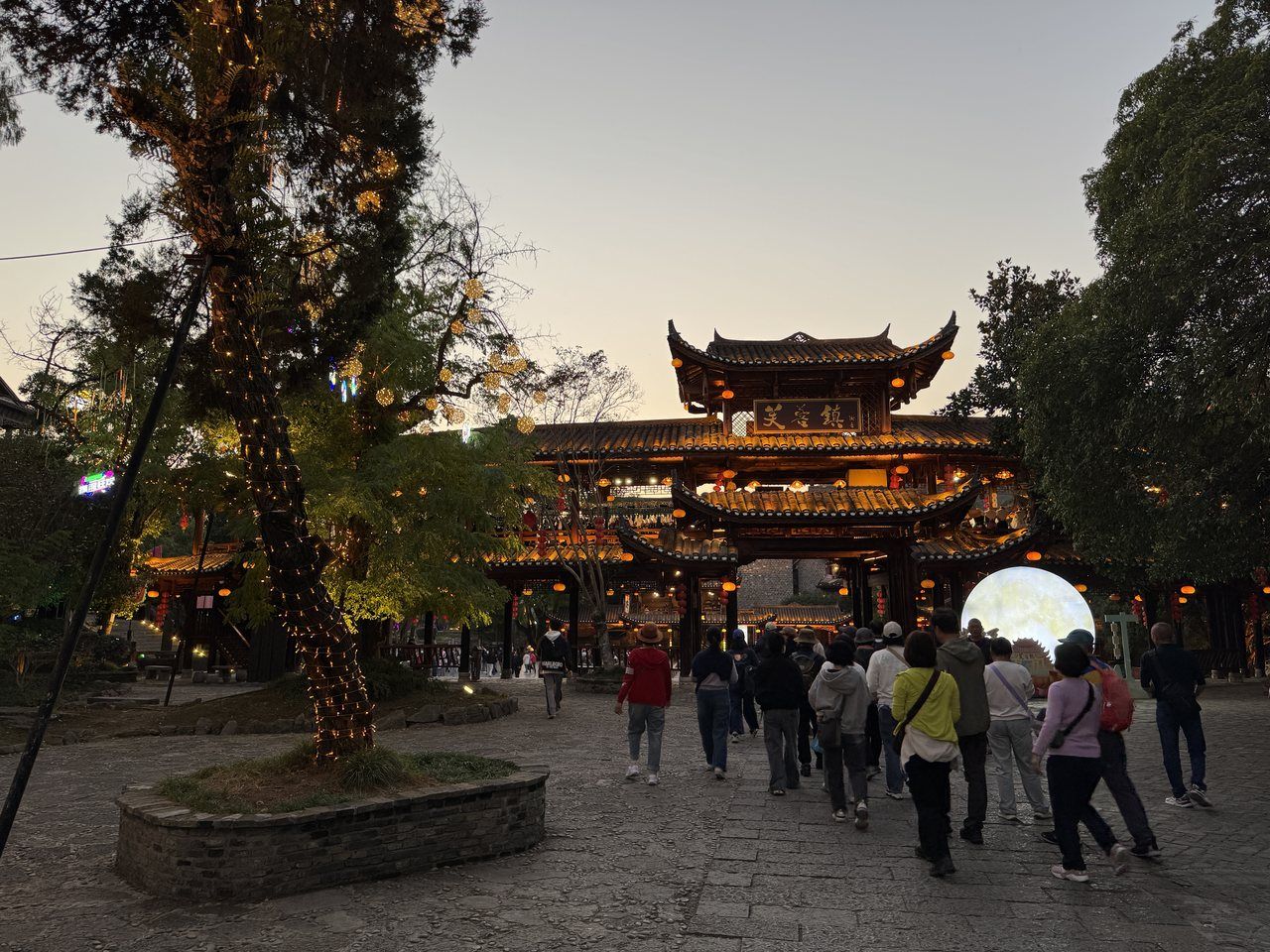
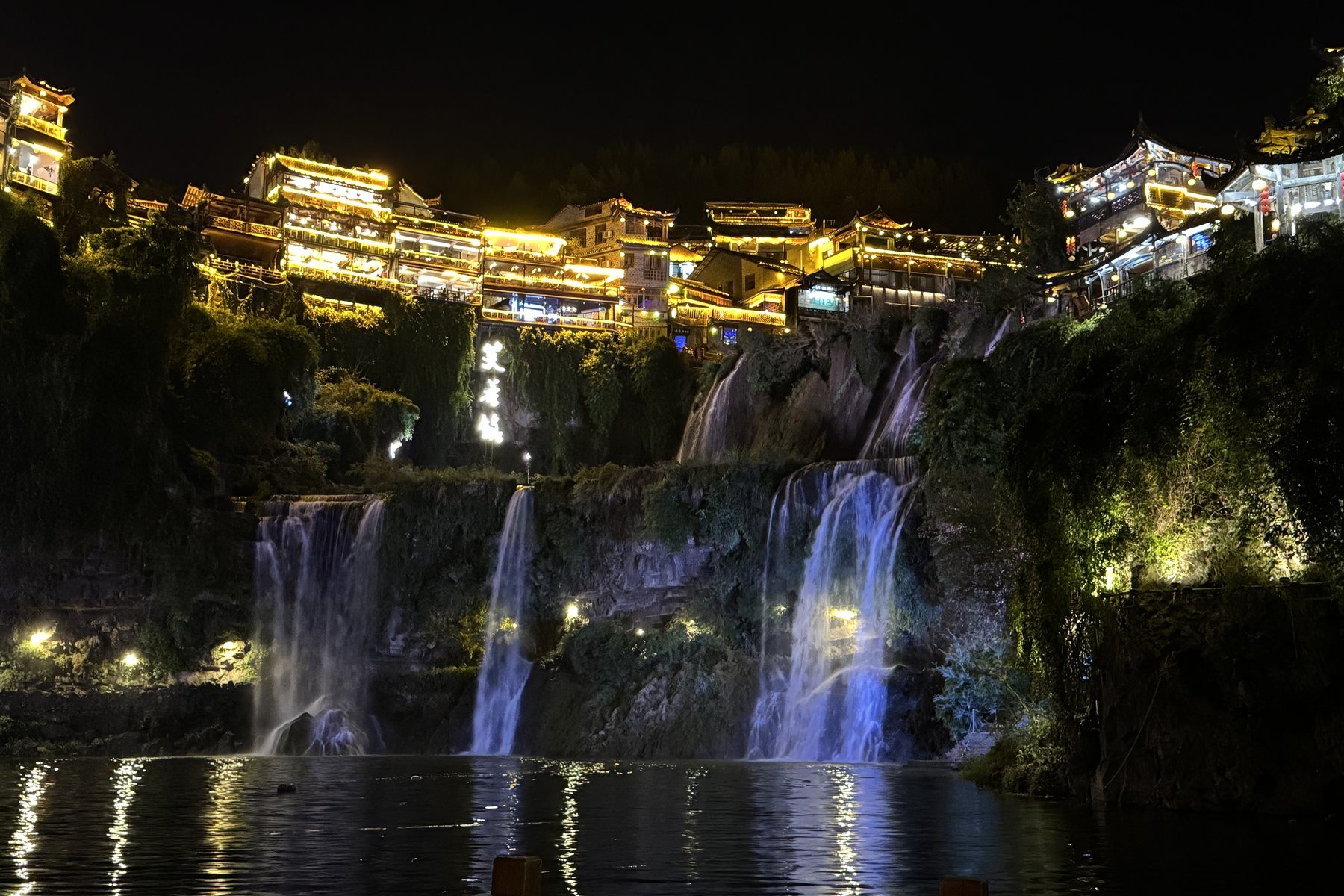
The town was called Wangcun for most of its two thousand years. In 1986 Xie Jin shot Hibiscus Town here, and the name stuck to the location. What made the film's setting distinctive is geological: a waterfall of roughly 60 metres drops through the centre of the settlement into the Youshui river, and the stilt houses are built on the cliffs to either side of it. The town is split in two by falling water, and the two halves are joined by stone steps and bridges over the spray.
That is the entire proposition, and it is a good one. Walk in from the gate, follow the flagstone street uphill through the old shopfronts, and you arrive at the viewing platform facing the fall. In the late morning the light comes in at an angle and throws a rainbow into the mist. After dark the water is lit gold and the whole town appears to float.
The ticket, in detail:
| Price | |
|---|---|
| Adult, gate price (includes the performance) | ¥108 |
| Adult, booked online | from ¥100 |
| Ages 14–18, or 60–65 | ¥54–60 |
| Full-time students | ¥60 |
| Ages 65–75 | ¥10, performance not included |
| 75 and over, or under 1.2 m | Free, performance not included |
Two things to know before you pay. First, the concession tickets for the 65–75 bracket exclude the show — if the performance is why you came, buy the full ticket. Second, online listings commonly describe the ticket as carrying multi-day re-entry; confirm it at the gate, because the town is at its best twice — at 19:30 and again at dawn — and that is worth structuring a night around.
Everything around the waterfall is a slope. The flagstone street climbs, the steps are wet near the fall, and there is no flat route between the gate and the viewpoint. This is not a place to arrive with a wheeled suitcase.
If you have a second day here, the Lao Sicheng ruins (老司城) are roughly an hour's drive away in Lingxi town — the seat of the Peng clan's Tusi kingdom for more than 800 years, inscribed by UNESCO in 2015 as part of the Tusi Sites. Gate price ¥118, from ¥98 online, including the shuttle and the museum, open 09:00–17:00. See the museum first; the ruins make far more sense with the sequence in your head. The Mengdong River rafting (猛洞河漂流) starts on the Furong Town side, runs about three hours, and costs from ¥198 — the government price ceiling is ¥80 in low season and ¥220 at peak, and it only operates roughly April to October.
Fenghuang: free streets, paid interiors
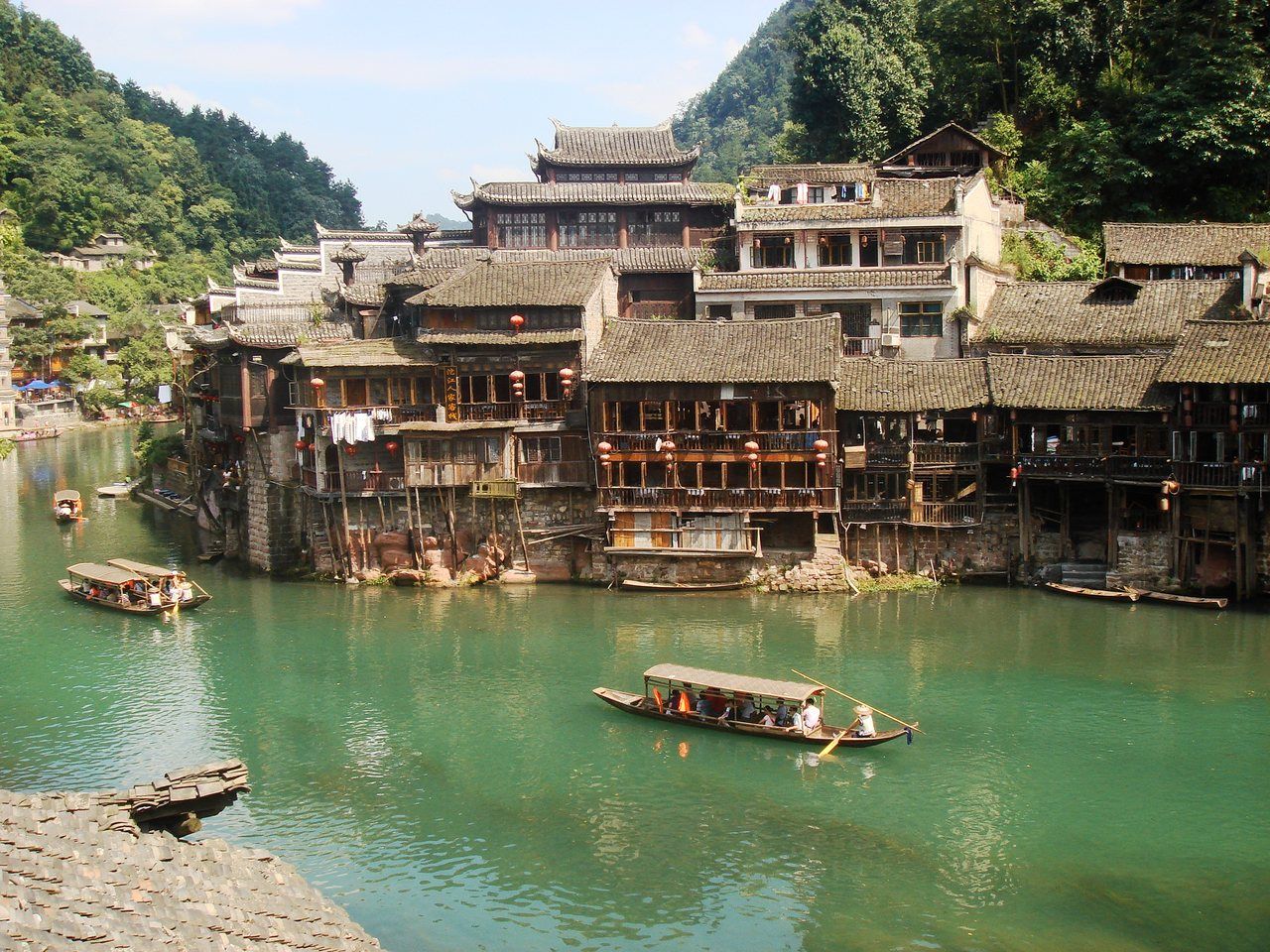
Fenghuang is a larger, older, more lived-in proposition, a county town that people actually live in rather than a preserved set. The Tuo river runs through it; both banks are lined with diaojiaolou — timber houses on stilts, some of them a century old, their supports standing in the water. The set pieces are the Tuo river stepping stones (跳岩), a line of stone blocks you cross on foot; the Hongqiao wind-rain bridge; the Wanming pagoda; and the lanes of the old town behind them.
Walking all of it costs nothing. That is the single most useful fact about Fenghuang, and it means the town works for travellers who arrive late, leave early, or have already spent their ticket budget elsewhere.
What costs money:
| Price | |
|---|---|
| Nine-sight pass (沈从文故居, 熊希龄故居, 虹桥, 东门城楼 and five more) | ¥128 (¥125 on some platforms) |
| Tuo river day cruise | ¥68–85 |
| Xiangjian Tuojiang night cruise, with the light-and-water show | ¥118–148 |
| Nanhua Mountain | ¥88 |
The nine-sight pass is worth it only if you will actually go inside three or more of the buildings. Most visitors walk the streets, take one boat, and skip the rest — which is a perfectly good use of Fenghuang and costs ¥68 to ¥148 rather than ¥128 plus a boat. Buy the pass on the day, once you have seen how much time you have, rather than in advance.
The night cruise is the one add-on most people are glad they paid for: the boats run from the North Gate dock, the route passes the stepping stones, the Snow Bridge, Hongqiao and the densest stretch of stilt houses, and the whole thing takes 30 to 40 minutes with a performance built into it. Lights come on around 19:00 and the best window is 19:00–21:00.
One correction worth making. Fenghuang is Shen Congwen's birthplace, and the town trades heavily on him. But the novel everyone associates with him, Border Town (边城), is set in Chadong — now Biancheng town, in neighbouring Huayuan county, and the setting of the prefecture's tourism conference in October 2026. Fenghuang's connection to Shen Congwen is biographical, not fictional. Guides that tell you Border Town happens in Fenghuang are wrong, and you will hear it more than once.
Why 2026 is the year both got busy
The prefecture published figures at the end of October 2026 that explain the crowds, and the breakdown is more interesting than the total:
| Figure | |
|---|---|
| Xiangxi inbound visitors, full-year 2025 | 335,700, spending US$130 million — third in Hunan |
| Xiangxi inbound overnight visitors, Jan–Sep 2026 | 240,700, spending over US$100 million |
| Furong Town inbound tickets, Jan–Sep 2026 | 314,100, up 59.03% year on year |
| Xiangxi inbound bookings on Ctrip, H1 2026 | up 239% year on year |
Read those two Furong Town numbers together and something odd appears: the scenic area sold 314,100 inbound tickets in nine months, in a prefecture that recorded 335,700 inbound visitors in a whole year. The ticket count is not a headcount of distinct people — it includes re-entries, and it counts a day visitor to a single ticketed sight. But the direction is unambiguous. One waterfall town absorbed a volume comparable to the entire prefecture's annual inbound traffic.
Ctrip's regional data adds the composition: growth is concentrated in long-haul markets — Spain, Italy, Russia and the United States — rather than in the nearby Asian markets that drive most Chinese inbound statistics. That is a different kind of visitor. They arrive on 240-hour visa-free transit, they book through cross-border platforms, and they stay.
The infrastructure has moved to meet them, unevenly. Across the prefecture, 153 foreign-card POS terminals are installed at 4A-and-above scenic areas, more than 820 merchants have been upgraded to accept foreign payment, and there are 15 currency exchange points. Fenghuang and Furong Town both have Chinese-English-Korean signage and audio guides across their core areas, and the prefecture has set up a dedicated foreign-language guide corps.
The bureau is also candid about what has not caught up: a shortage of senior foreign-language staff, hotels in remoter counties that cannot reliably register foreign guests, and bottlenecks in getting departure-tax-refund facilities to work at county level. Practically, that means the signage is fine and the people are not always. Outside the two headline towns, English is thin.
Getting there: one rail line, 40 minutes apart
Both towns sit on the Zhangjiajie–Jishou–Huaihua high-speed line, which is the single fact that makes a two-town trip reasonable. There is a station named Furong Town and a station named Fenghuang Ancient Town, and they are one stop apart.
| Journey | Time | Second class |
|---|---|---|
| Zhangjiajie West → Furong Town | 23–30 min | — |
| Furong Town → Fenghuang Ancient Town | 33–40 min, about 12 trains a day | ¥43–53 |
| Zhangjiajie West → Fenghuang Ancient Town | 51 min – 1 h 6 min | ¥77–93 |
| Changsha South → Furong Town | about 2 h 35 min | — |
From Fenghuang Ancient Town station, the shuttle into the old town is ¥7 and takes about 20 minutes; a taxi is around ¥30 and 15–20 minutes. There is also a maglev link. From Furong Town station, the old town is about 5 km away — 10 to 15 minutes by shuttle or taxi. Use the licensed queue at both; the informal drivers work the same exits.
By air, the realistic options are Zhangjiajie Hehua airport (then the high-speed line south), Tongren Fenghuang airport about 30 km from Fenghuang, or Xiangxi Biancheng airport, which shares the Zhangjiajie airport's international port status. From Tongren Fenghuang, a bus takes about an hour; a car, 30 minutes.
Cars cannot enter Fenghuang's core at all — park at the North Gate or Nanhua Gate lots, ¥20–40 a day. Furong Town's core is pedestrian too.
Which one, if you only have one day
Three honest rules.
Arriving from Zhangjiajie with one day to spare: go to Fenghuang. It is 51 minutes away, entry is free, and there is no ticket decision to make before you have seen the place. You can walk in, decide on the spot whether the nine-sight pass is worth it, take a boat at dusk, and be back on a train the same night.
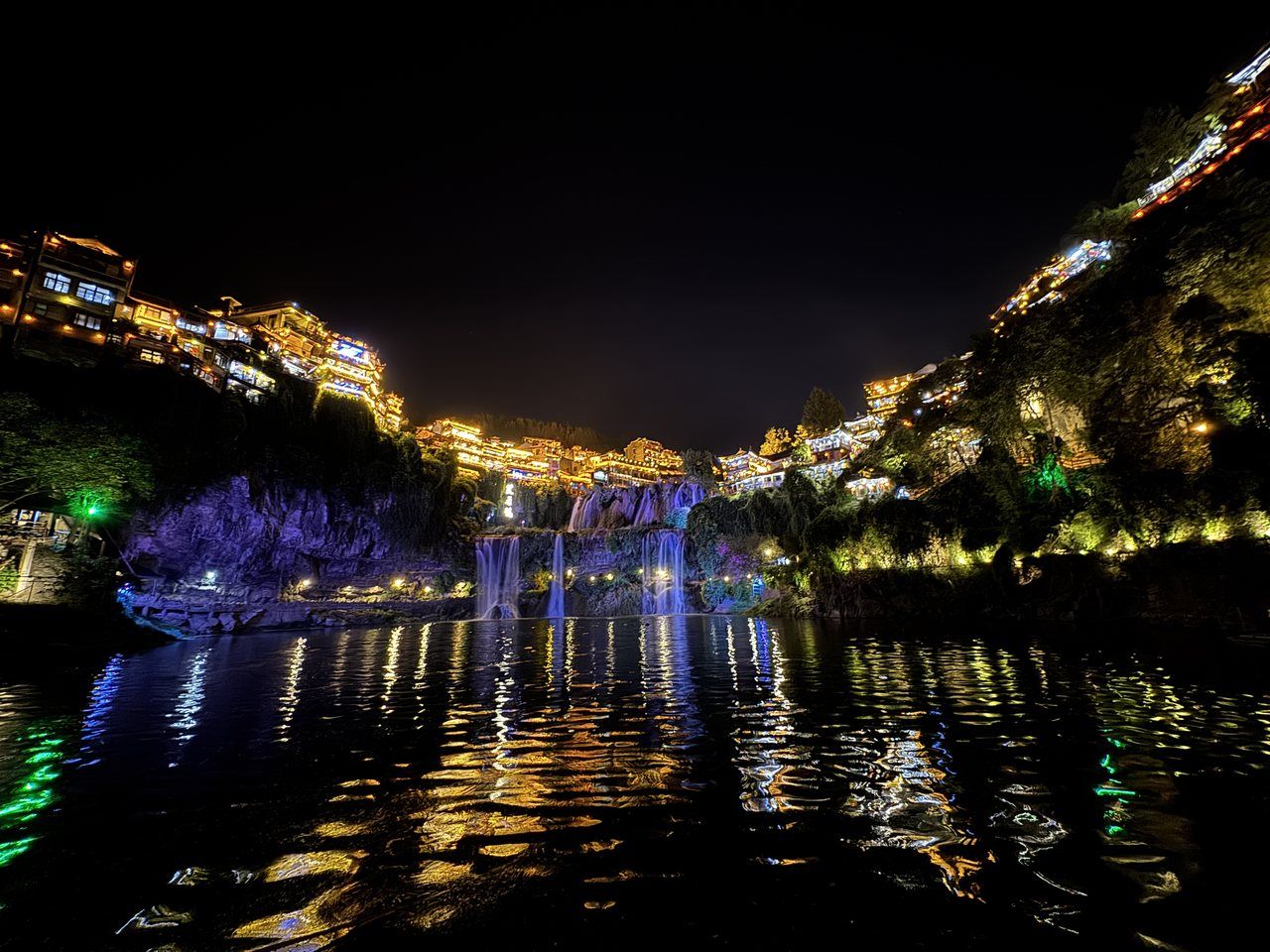
Want the single most photogenic hour in the region: go to Furong Town. The 19:30 lighting of the waterfall is the thing people photograph, and it does not have an equivalent in Fenghuang, whose night is broader and softer — hundreds of houses lit at once rather than one wall of water.
Have two days: sleep in Fenghuang and day-trip Furong Town, not the reverse. Fenghuang's free entry means an evening arrival costs you nothing, its riverside guesthouse stock is far larger, and the early-morning mist on the Tuo is the best thing either town does. Furong Town's cliff rooms facing the waterfall are spectacular and few — book them if you want them, but do not build the trip around availability.
If you are doing both, the sequence that works is: Fenghuang in the evening and the following dawn, then the 33-minute train to Furong Town for the afternoon and the 19:30 lighting. That is one night, two towns, and no wasted transfers.
Things that will cost you money if you do not know them
The Furong Town ticket is genuinely checked. There is no free back entrance and no viable "just walk in" route. Buy at the gate or through an official channel and expect to show ID at the concession rate.
Do not buy the Fenghuang nine-sight pass in advance unless you have already decided to go inside the buildings. The streets are the attraction for most people.
Traditional costume photo shoots quote per outfit, not per hour. Agree the total, including hair and makeup, before the first frame. The going rate for a basic rental is ¥20–50.
Carry some cash. Small vendors and the older shops on both sides still operate that way, and foreign cards work at the upgraded merchants, not at a noodle stall.
Both towns are stone steps and slopes. Flat shoes are not a suggestion. Fenghuang's lanes are slick after rain; Furong Town's are wet whenever the waterfall is running, which is always.
Ticket prices, opening hours and train times were checked on 2026-10-30 against the scenic areas' platform listings and the 12306 timetable, and can change without notice — confirm on the day. The inbound-visitor figures are the Xiangxi prefecture tourism bureau's own, as reported by Xinhua and Reference News on 2026-10-29, not provincial or national statistics; "inbound" follows the Chinese statistical convention and includes Hong Kong, Taiwan and Macao residents as well as foreign nationals. The Furong Town ticket count measures tickets sold to inbound visitors, not distinct individuals, and is not directly comparable with the prefecture's visitor headcount.