Dujiangyan Tickets for Foreign Visitors: The ¥80, the Passport Line, and the Qingcheng Mountain Mistake
Status check (verified 2026-10-24): the Dujiangyan scenic area ticket is ¥80 and Qingcheng Mountain's front gate is a separate ¥80 — buying one does not get you into the other. Passports are accepted at the ticket window and there is a dedicated inbound-visitor counter at the visitor centre by the Lidui Park entrance. Prices are re-checked each season; confirm the day's figure at the window.
On this page
- What the ¥80 ticket actually covers
- The Qingcheng Mountain mistake
- Three ways to buy, and which one to use
- Why a guide earns its money here
- Getting there from Chengdu
- Paying for things once you are inside
- Why this is being written now
- FAQ
- How much is the Dujiangyan ticket?
- Does the Dujiangyan ticket include Qingcheng Mountain?
- Can I buy a ticket with a passport?
- Do I need to book ahead?
- How long should I allow?
- Is it worth it if I have seen the photos?
- What's worth booking ahead
In mid-October, a Chinese business newspaper sent a reporter to the Bell Tower in Beijing and watched two Italian tourists try to buy tickets. The only instructions at the entrance were in Chinese, on a mini-program. They entered their passport numbers, the payment failed twice, and they ended up walking across the street to buy paper tickets at the Drum Tower instead. Nobody at the Bell Tower had told them that was an option.
That is the ordinary version of this problem. Dujiangyan is the version where somebody sat down and solved it.
The irrigation system 55 km west of Chengdu is one of China's most-visited paid sites and, by a wide margin, the easiest major attraction in the country to buy a ticket for without reading Chinese. What follows is what the ticket covers, what it does not, and the one mistake that costs foreign visitors a wasted half-day.
What the ¥80 ticket actually covers
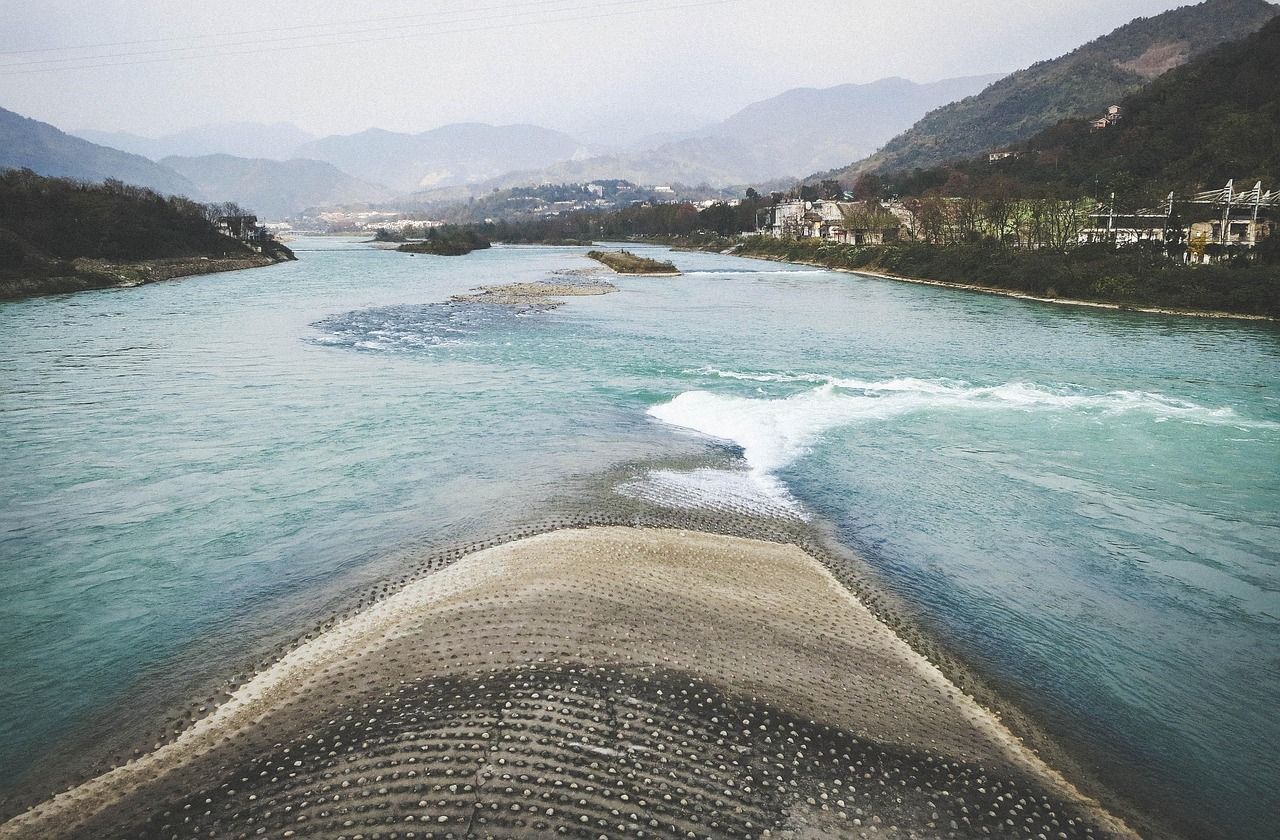
The Dujiangyan scenic area is a single ticketed zone built around three hydraulic structures that sit within about two kilometres of each other along the Min River:
The Fish Mouth (Yuzui) — the pointed levee that splits the river into an inner channel for irrigation and an outer channel for floodwater. It is the piece that gives the whole system its logic, and it is why the site is a UNESCO World Heritage listing rather than a nice riverside park.
The Flying Sand Weir (Feishayan) — the spillway that dumps excess floodwater and, in the process, flushes sediment out of the inner channel. This is the part most visitors walk past without noticing, and the part engineers come for.
The Baopingkou (Bottle-Neck Channel) — the narrow gap cut through solid rock that controls how much water enters the Chengdu plain. It is the only one of the three that is a hole in a mountain rather than a shape in a riverbed.
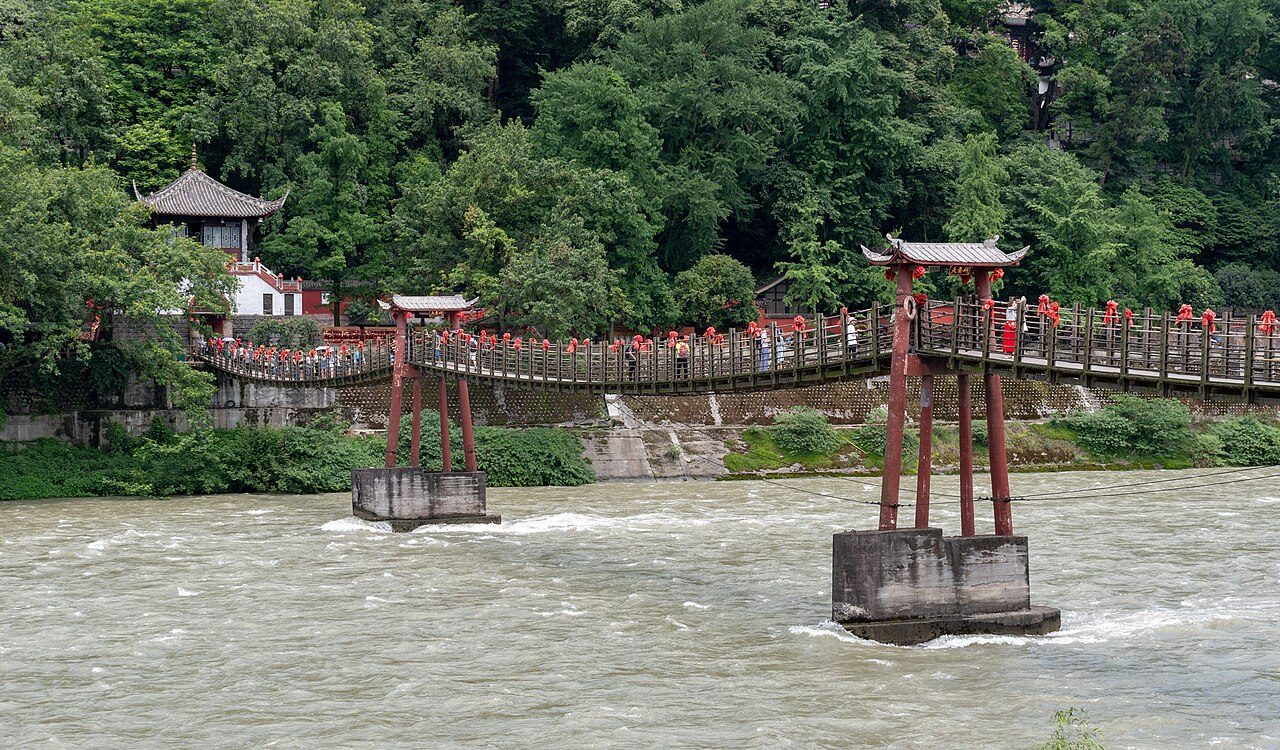
The ticket also covers the Anlan suspension bridge across the Min River, the temple halls on the Lidui side including Fulong Temple, and the halls on the far bank. The classic route runs one way: enter at the Lidui Park gate, walk the Baopingkou gap, cross the Anlan bridge, climb to the halls above it, and take the shuttle back to the gate. On foot that is 2.5–4 km with stairs; the internal shuttle is ¥10 a segment if you would rather not.
One warning that has nothing to do with tickets: the water is fast and the rocks are slick. The site is a working diversion scheme, not a landscaped park, and the railings along the inner channel are the only thing between you and a very cold river.
The Qingcheng Mountain mistake
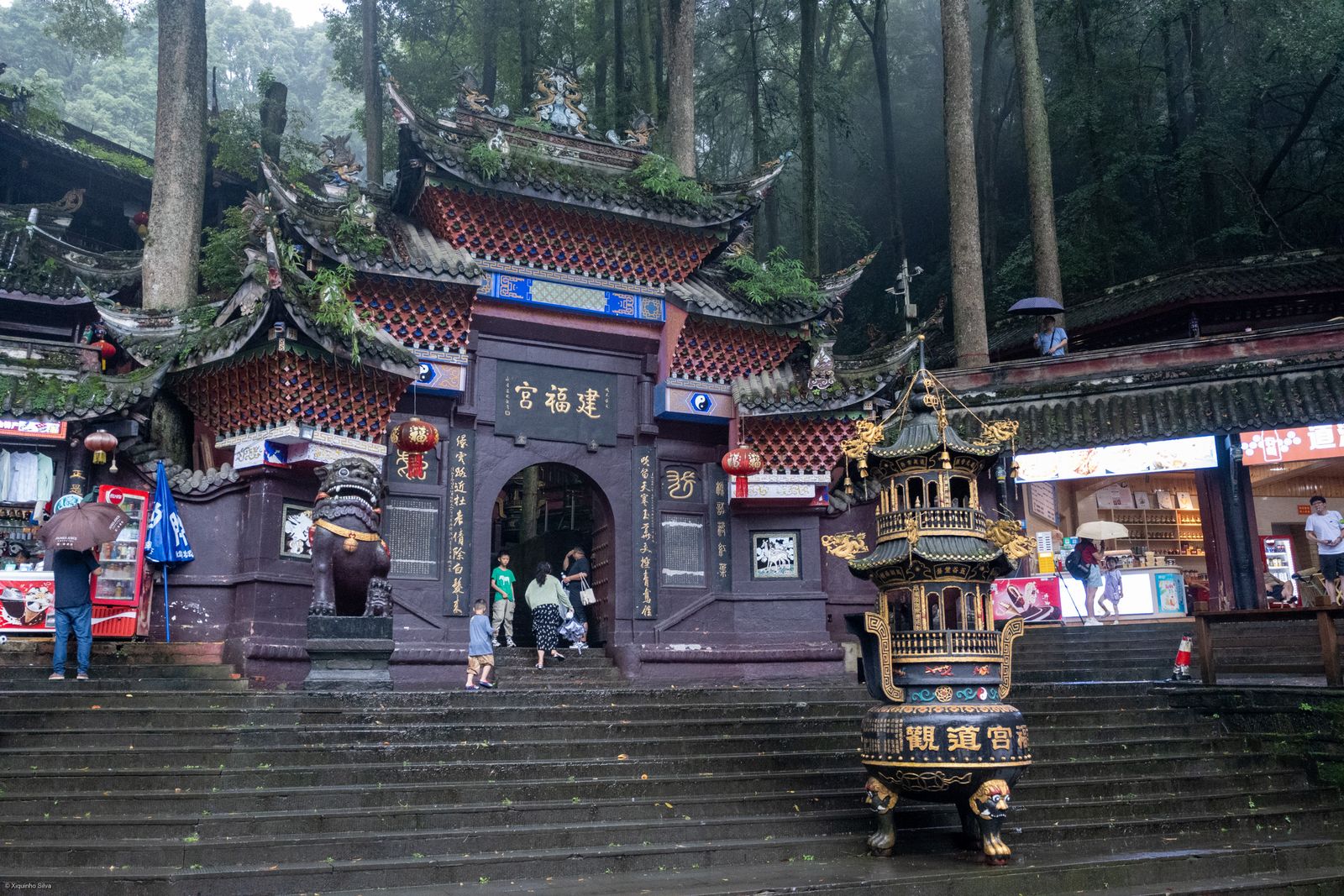
Qingcheng Mountain is 20 minutes by road from Dujiangyan, shares a World Heritage listing with it, and appears in every guidebook on the same page. So people assume one ticket, or one day, covers both.
It does not. Qingcheng Mountain's front gate (Qianshan) is ¥80 on its own, and the Dujiangyan ticket does not touch it. Two adults doing both in one day spend ¥320 on gate tickets before a cable car, a shuttle or a boat.
There are also two Qingcheng Mountains, and they are not the same trip:
- Front mountain (Qianshan), ¥80. Taoist temples on a forested slope, a cable car to the upper halls, and the version most tour groups take. Half a day minimum if you ride up and walk down.
- Back mountain (Houshan), about ¥20. Waterfalls, stream paths and a long staircase through gorge scenery. Cheaper, quieter, and a genuine hike rather than a temple visit.
Doing Dujiangyan properly takes three to four hours. Adding the front mountain makes it a full, tiring day. If you only have one day from Chengdu, pick one. If you want both, sleep in Dujiangyan town and start early — the Anlan bridge is empty before 9am and unbearable at 11.
Three ways to buy, and which one to use
The inbound-visitor counter. At the visitor centre beside the Lidui Park entrance there is a dedicated counter for foreign visitors. Your passport is the ID document — no Chinese ID number, no local phone number, no mini-program. If you also want an audio guide, a route suggestion or a map in English, this is the one stop where you get all of it.
A foreign bank card at the window. The ticket office takes overseas cards directly, and a ticket prints in well under a minute. This is the fastest route if you have nothing to ask and just want to be inside.
Online, before you go. The scenic area sells through authorised Chinese platforms, and foreign visitors can book there. The catch is the one the Italian tourists hit in Beijing: some pages exist only in Chinese, and the passport number has to match your document character for character, or the booking will not scan at the gate. If it is your first time, use one of the first two.
If something goes wrong, the scenic area runs a foreign-visitor service line on 96099 — tickets, refunds, guides, lost property. Calling it is faster than queueing at a gate to explain a problem in gestures.
Why a guide earns its money here
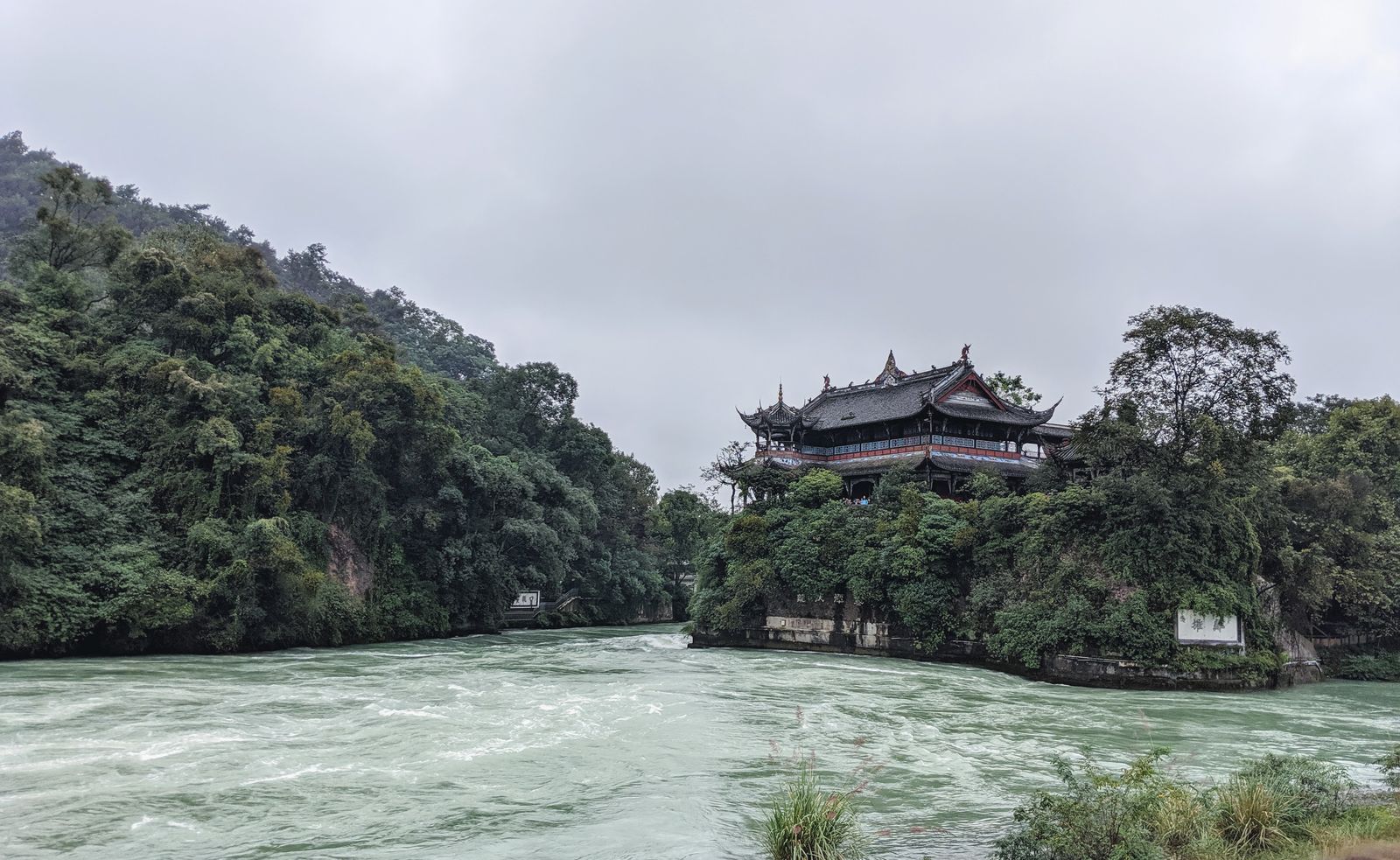
Dujiangyan has an unusual problem: it is not hard to see, it is hard to understand. Three low structures across a river look like almost nothing. Without someone explaining what the water is doing, you are looking at a wide grey river for an hour.
The system was built around 256 BC by Li Bing, a Qin state governor, and it has been running ever since — no dam, no gate, no pump, nothing that needs to be switched on. Its maintenance rule is still quoted in Chinese engineering schools: dredge the channel deep, keep the weir low. The design has survived earthquakes, floods and two thousand years of silt because it works with the river's own flow rather than against it.
Four ways to get that story, in order of convenience:
Rent an audio guide. The scenic area runs a fleet of roughly 1,100 units in English, Japanese and Korean, rented and returned at the visitor centre.
Book an English-speaking guide. The main sites staff English-speaking guides and reception staff, arranged through the inbound counter. Ask a day ahead in high season.
Use the translation screens. The site installed AI translation screens covering 14-plus languages — billed as the first installation of its kind in China. They are for asking directions, prices and where the toilets are, not for history.
Read the signs. About 576 multilingual signboards were replaced across the main routes, so directions, prohibitions and the main interpretive panels carry English.
Getting there from Chengdu
The simplest route is the intercity train. Take metro Line 2 to Xipu, change to the Chengdu–Dujiangyan line, and get off at Lidui Park station — the scenic area gate is a ten-minute walk. The ride is around 30 minutes and costs about ¥10. Trains run frequently; you do not need to book ahead.
The alternative is a train to Dujiangyan station, then local bus 4. Slower, and it drops you on the wrong side of town.
Two things worth folding into the same day, each on its own ticket:
- Panda Valley (Xiongmao Gu), ¥55, on the edge of Dujiangyan — a smaller, quieter panda facility than the Chengdu base, and the one locals recommend when the city base is packed.
- Nanqiao bridge and the old town at the scenic area's edge — free, and where you end up for dinner anyway.
Paying for things once you are inside
This is where inbound travel in China usually gets stuck, and Dujiangyan has gone further than most. Roughly 290 foreign-card POS terminals and ATMs are deployed across the town's main sites, hotels and guesthouses, along with about 37 currency exchange points. An inbound service platform at the ticket desk settles in 41 currencies. Alipay tap-to-pay terminals with Chinese–English interaction are installed at the main gates.
Still carry some cash. Machines fail, mountain signal drops, and a ¥3 bottle of water is not worth a fifteen-minute argument with a card reader.
Why this is being written now
On 18 October, at the China Tourism Industry Development annual conference in Shiyan, Hubei, Dujiangyan was named an influence case for inbound-tourism service improvement — the fifth consecutive year it has appeared on that list, and more than any other district in Sichuan.
The traffic backs the award up. Between January and July 2026, Dujiangyan's key scenic areas — Qingcheng Mountain–Dujiangyan, Panda Valley and the China Giant Panda Garden — recorded 336,600 inbound visits, up 33.05% year on year. In 2025 the Qingcheng Mountain–Dujiangyan scenic area alone drew 286,400 overseas visitors, up 51.05%.
One caveat on those numbers, because they get mixed up in Chinese coverage too: the 107,800 figure quoted for the first half of 2026 covers the Qingcheng Mountain–Dujiangyan scenic area only, while the 336,600 covers all the key sites including the two panda facilities. They are not comparable, and neither is a count of foreign nationals specifically.
What the service build-out actually buys a visitor is narrower and more useful than a plaque: at Dujiangyan, someone who does not read Chinese can arrive without a guide, buy a ticket, understand what the three structures do, and leave — which is still not the norm at Chinese 5A sites.
FAQ
How much is the Dujiangyan ticket?
¥80 for adults at the gate. Students pay half with a valid student card. The internal shuttle is ¥10 a segment and is not included.
Does the Dujiangyan ticket include Qingcheng Mountain?
No. Qingcheng Mountain's front gate is a separate ¥80, and the back mountain is about ¥20. The two sites share a World Heritage listing, not a ticket.
Can I buy a ticket with a passport?
Yes. The ticket window and the inbound-visitor counter both accept passports as ID. You do not need a Chinese ID number or a local phone number.
Do I need to book ahead?
For the scenic area itself, no — same-day tickets are sold at the gate. Book ahead if you want an English-speaking guide in high season, or if you are visiting during a national holiday week.
How long should I allow?
Three to four hours for Dujiangyan on the classic one-way route. A full day if you add Qingcheng Mountain's front gate, and you should then start before 9am.
Is it worth it if I have seen the photos?
The photos undersell it and also mislead. It is not a scenic gorge; it is a 2,300-year-old piece of engineering that still waters the Chengdu plain. Go with someone or something explaining it, or go for the walk and skip the history.
What's worth booking ahead
The gate sells same-day tickets, so nothing here needs reserving in advance. What is worth arranging before you arrive is a guide — the interpretive signs are English, the story is not — and anything you plan to pair with the same day:
Image sources: stock/library photos, credited where required.